Friday, April 24, 2026
If you own a home in Calgary and are thinking about adding a carriage house (also known as a laneway house, garden suite, or backyard suite) in your backyard, understanding the rules is the most important first step. In 2026, the City of Calgary continues to support these small secondary dwellings as a smart way to add housing without changing the character of existing neighborhoods.
The rules are designed to make sure carriage houses are safe, respectful to neighbors, and fit well into residential areas. While some homeowners worry the process is complicated, the rules are actually quite straightforward once you know them. This detailed guide explains everything in simple, clear language: what size you can build, height limits, parking requirements, setback distances, how to use the Infill Fast Track program to speed things up, and practical tips to avoid common problems.
By the end, you’ll have a complete understanding of the 2026 carriage house regulations and feel confident about whether this is a good option for your property.
What Is a Carriage House Under Calgary Rules?
A carriage house is a small, self-contained secondary home built on the same lot as your main house. It is completely separate from the main dwelling and has its own entrance, kitchen, bathroom, and living space. It can be built as a standalone structure or, more commonly, above a garage.
Key point: It must always remain secondary to the main house. This means it cannot be larger or taller than allowed, and it should not dominate the property or the street.
Carriage houses are permitted in most low-density residential zones (such as R-C1, R-C2, and similar districts), but you must follow the specific rules for your property’s land use district.
Maximum Size Rules in 2026
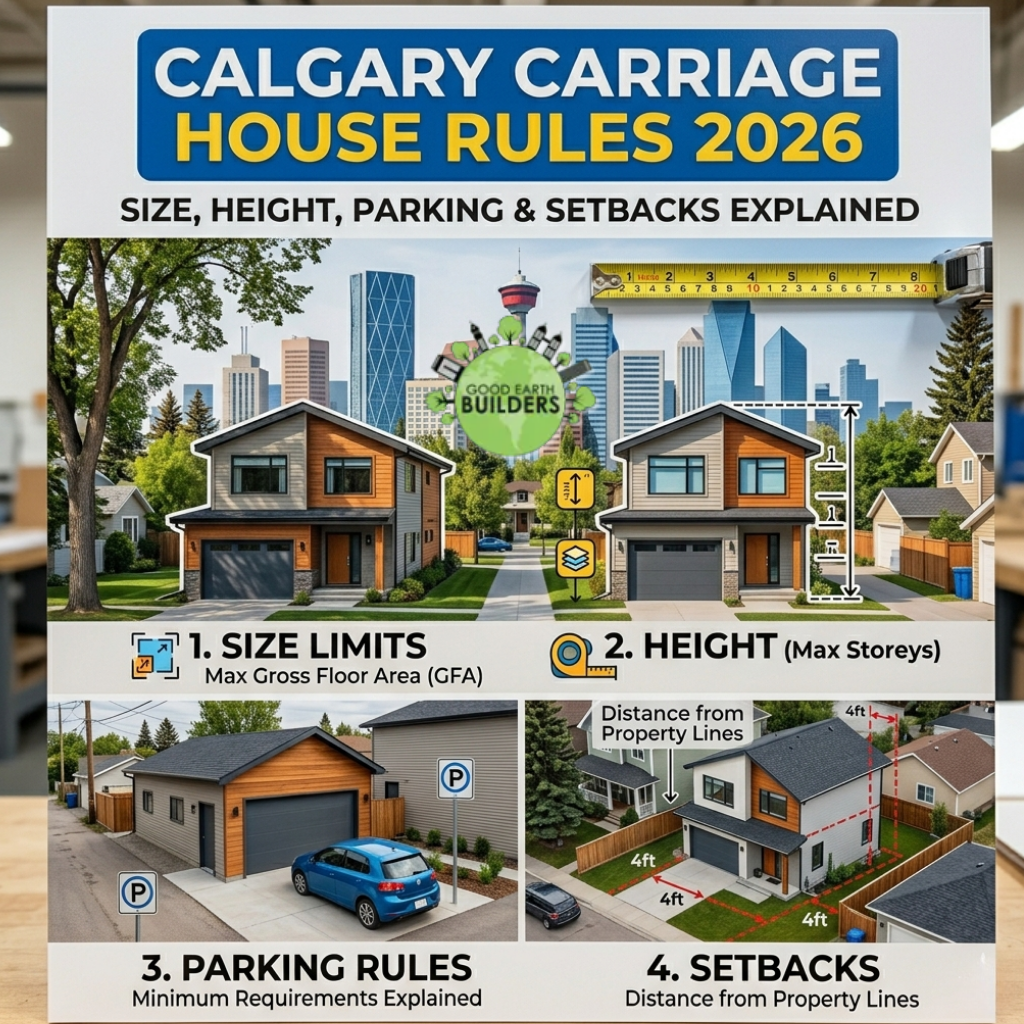
Living Space Limit: The maximum floor area for the living space inside the carriage house is typically up to 1,000 square feet (check your exact land use district, as it can vary slightly). This includes all floors but usually excludes the garage area below if it’s a garage suite.
Building Envelope (Overall Size): The total building size (including walls and roof coverage) is limited so the carriage house does not overwhelm the main house or the lot. In practice, most approved carriage houses range from 600 to 950 square feet.
Important Restriction: The carriage house cannot be the same size or larger than the main house in terms of building envelope or total floor area. The main house must clearly remain the primary building on the lot.
Tip: Many successful projects stay in the 700–850 sq ft range. This size gives you comfortable 1- or 2-bedroom living space while easily meeting city rules.
Height Restrictions in 2026
General Height Limit: Most carriage houses are limited to 2 storeys or approximately 8 to 9 metres (about 26–30 feet) in height, depending on the specific zoning district.
Roof Design Rules:
- Sloped roofs are often preferred as they look more like traditional homes.
- In some districts, the roofline must slope down toward neighboring properties to reduce shadow impact.
- Flat or low-slope roofs are possible but require extra attention to drainage and snow load.
Why Height Matters: These limits help protect sunlight and privacy for neighboring yards. Designs that are too tall or bulky often face neighbor objections or require variances, which slow down the permit process.
Parking Requirements for Carriage Houses
Standard Rule: You normally need at least one dedicated parking stall for the carriage house.
Flexible Options in 2026:
- The stall can be in tandem (one behind the other) on the driveway.
- In some districts near transit or with good main-house parking, the requirement may be reduced or waived.
- Shared parking arrangements can sometimes be approved if clearly shown on plans.
Practical Tip: Plan your driveway and parking early in the design stage. Good parking design helps your application get approved faster and reduces neighbor concerns about street parking.
Setback Requirements (How Close You Can Build to Property Lines)
Setbacks are the minimum distances your carriage house must stay from property lines. These rules protect privacy, fire safety, and access.
Typical Setbacks in 2026:
- Rear setback (from the lane): Minimum 1.2 metres (about 4 feet) in most cases.
- Side setbacks: Usually 1.2 metres from each side property line.
- Front setback: Generally measured from the main house rules, but the carriage house is in the backyard so this is less relevant.
Additional Fire Safety Separation: You need enough space between the main house and the carriage house for fire safety (often 3–5 metres or more, depending on design).
Tree Protection: Mature trees on or near the lot often require protection plans. The city takes tree preservation seriously.
Enmax Power Line Setbacks: If there are overhead power lines at the back of your lot, you may need extra distance for safety.
How to Use Infill Fast Track to Get Your Permit Faster
The Infill Fast Track program is one of the best tools for carriage house owners in 2026. Qualifying projects get faster review — often 3–5 months instead of 6–12 months.
To Qualify:
- Your design must respect neighborhood character (scale, height, materials).
- Include energy-efficient features where possible.
- Submit a complete, high-quality application package the first time.
Projects that follow the guidelines closely and show respect for neighbors usually move through the system quickly.
Step-by-Step Permit Process in 2026
- Research your property (zoning, setbacks, restrictions).
- Book a pre-application meeting with the City Planning department.
- Hire professionals (designer/architect + surveyor).
- Prepare complete drawings and documents.
- Submit the application online and request Infill Fast Track.
- Respond quickly to any city or neighbor questions.
- Receive approval and apply for building permit.
- Build and get final inspections.
Common Reasons Applications Get Delayed
- Incomplete drawings or missing information
- Designs that are too big or too tall
- Poor neighbor communication
- Not protecting trees or drainage issues
- Starting construction before permits are approved (never do this)
Real Calgary Examples from Recent Years
Many homeowners in neighborhoods like Bowness, Killarney, Highland Park, and West Hillhurst successfully permitted carriage houses in 2025–2026 by following the rules carefully and using Infill Fast Track. Projects that included good design, proper setbacks, and energy features were approved faster and with fewer revisions.
Final Thoughts
Calgary’s carriage house rules in 2026 are designed to be practical and supportive. The limits on size, height, parking, and setbacks help ensure these small homes fit nicely into existing neighborhoods while still giving homeowners valuable extra space and income opportunities. Understanding the rules clearly — especially maximum size (around 1,000 sq ft), height limits (usually 2 storeys), minimum setbacks (1.2 metres), and parking requirements — is the key to a smooth and successful project.
With good planning, professional help, and use of the Infill Fast Track program, many Calgary residents are getting their carriage house permits approved in just a few months. When built correctly, these backyard suites provide excellent long-term value, rental income potential, and increased property worth while contributing positively to the community.
If you’re thinking about adding a carriage house to your Calgary property in 2026 and want expert guidance on rules, design, permitting, costs, incentives, and construction that meets all city requirements, working with experienced local builders who have completed many successful carriage house projects can save you time, money, and stress.
Good Earth Builders, with over 23 years of experience in the Calgary market and 846 completed projects, has helped numerous homeowners navigate the carriage house permitting process successfully. They understand the current 2026 rules, Infill Fast Track program, and how to create designs that get approved efficiently while delivering great results. Their commitment to planting 10 trees for every job also adds real environmental value to each project.
If you’re ready to explore building a carriage house, reaching out to a team like Good Earth Builders can give you clear answers and practical support to make the process as smooth as possible.