Monday, February 23, 2026
Buying or building a home in Calgary is one of the biggest financial decisions most people will ever make. In 2026, with the city’s population still growing, construction costs stabilizing after years of inflation, and a market that rewards energy-efficient and well-located properties, many buyers are asking the same question: Should I buy a production home from a big developer or build a custom home from the ground up?
A production home (also called a tract or spec home) is built in large subdivisions using standard designs and materials. Think of the cookie-cutter houses you see in new communities like Sage Hill, Seton, or Evanston. A custom home is designed and built specifically for you, often on an infill lot in an established neighborhood or on acreage outside the city.
Both options have advantages, but which one actually delivers better return on investment (ROI) in Calgary right now? ROI in real estate comes from three main sources: resale value growth, rental income (if you don’t live there), and long-term savings (lower maintenance and energy bills).
This guide breaks everything down in plain English. We’ll compare costs, build times, resale potential, rental yields, incentives, risks, and real Calgary examples. By the end, you’ll have a clear picture of which path is likely to give you the best financial outcome in 2026.
What Exactly Is the Difference Between Custom and Production Homes?
To understand ROI, you first need to understand the two approaches.
Production Homes
- Built by large developers on pre-approved lots in new communities.
- Standard floor plans with limited customization options (upgrades like countertops or flooring).
- Faster build time (4–8 months).
- Lower upfront cost because of economies of scale.
- Common in suburbs with new infrastructure (schools, parks, transit).
Custom Homes
- Designed from scratch or heavily modified based on your needs.
- Built on your chosen lot (often infill in mature neighborhoods).
- Full control over layout, materials, finishes, and features (energy efficiency, smart tech, unique designs).
- Longer build time (8–18 months).
- Higher upfront cost but potential for greater long-term value.
In Calgary’s 2026 market, production homes are still popular for first-time buyers who want to move quickly and affordably. Custom homes appeal to people who want to live in established neighborhoods, add energy-efficient features, or create a one-of-a-kind home that stands out.
Cost Comparison: Custom vs Production Homes in Calgary 2026
Let’s look at realistic numbers for a typical 2,200–2,500 sq ft home.
Production Home Costs (2026 estimates)
- Base price: $450,000–$650,000
- Upgrades and lot premium: $50,000–$150,000
- Total landed cost: $500,000–$800,000
- Build time: 4–8 months
- Soft costs (closing, taxes, moving): $20,000–$40,000
Custom Home Costs (2026 estimates)
- Land (infill lot): $400,000–$800,000
- Design and engineering: $20,000–$50,000
- Construction: $400–$800 per sq ft (total $880,000–$2,000,000)
- Permits and fees: $30,000–$60,000
- Total landed cost: $1.3M–$3M+ (depending on size and finishes)
- Build time: 8–18 months
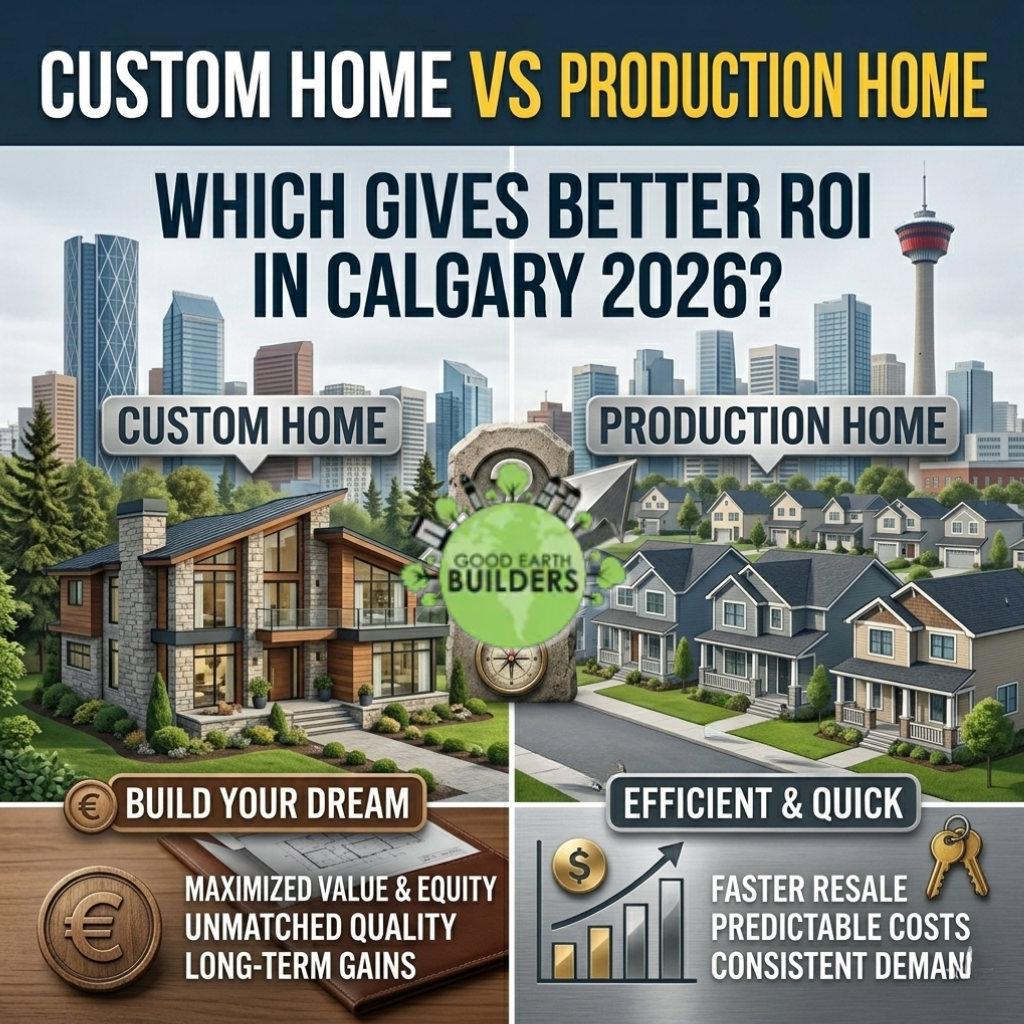
Key Insight: Production homes are cheaper and faster upfront. Custom homes cost more initially but often deliver higher resale value and lower ongoing costs because of better materials and energy efficiency.
For a visual cost comparison, many Calgary buyers reference tools like the CMHC Homebuying Budget Calculator or local builder estimators.
ROI Breakdown: Resale Value, Rental Income, and Long-Term Savings
ROI is what really matters. Here’s how the two compare in Calgary 2026.
Resale Value Growth
- Production Homes: Appreciate steadily (2–4% per year) because they are in new communities with amenities. However, they can feel “cookie-cutter,” which may limit premium pricing.
- Custom Homes: Often appreciate faster (4–7% per year) in mature neighborhoods like West Hillhurst, Mount Pleasant, or Elbow Park. Unique features, better energy efficiency, and location drive higher resale prices. Many custom homes sell for 5–15% more than comparable production homes in the same area.
2026 Projection: A $600,000 production home might be worth $700,000–$750,000 in 5 years. A $900,000 custom home in a desirable infill area could reach $1.1M–$1.3M in the same period.
Rental Income Potential
- Production Homes: Good for rentals in suburbs ($2,000–$3,000/month for a 3-bed). Yield around 4–6%.
- Custom Homes: Higher potential if built with legal basement suites or in high-demand areas. Custom energy features can command premium rents ($2,500–$4,000/month). Yield 5–8%.
Long-Term Savings
- Production Homes: Standard efficiency means higher utility bills ($200–$400/month heating/cooling).
- Custom Homes: With heat pumps, better insulation, and solar-ready designs, utility bills can drop 30–50% ($100–$250/month). Over 10 years, that’s $10,000–$30,000 in savings.
Overall ROI Winner: Custom homes usually win for long-term ROI in Calgary because of higher resale appreciation and lower operating costs. Production homes win for short-term buyers who want quick move-in and lower entry price.
Incentives and Financing Differences in 2026
Both options can access incentives, but custom homes often qualify for more.
Common Incentives
- CMHC Eco Improvement Refund (up to 25% on mortgage premiums for energy upgrades)
- CEIP rebates (10% back on energy-efficient features)
- GST rebate for new builds
- Provincial low-carbon grants
Custom Homes benefit more because you control the design (e.g., adding heat pumps or solar from day one). Production Homes may already include some green features but offer less flexibility for maximum rebates.
Financing is easier for production homes (developers often have pre-approved mortgages). Custom homes require stronger equity and detailed plans but can access specialized construction loans from ATB or credit unions.
Design Flexibility and Lifestyle Fit
This is where custom homes shine.
- Production Homes: Limited choices. You pick from a few floor plans and upgrade packages.
- Custom Homes: You decide everything — open-concept layouts, multi-generational suites, home offices, smart tech, or energy-efficient features that suit Calgary’s cold winters and hail-prone summers.
In 2026, buyers increasingly want homes that support hybrid work, multi-generational living, and lower energy bills. Custom homes deliver this better.
Risks and Challenges in Calgary 2026
Production Homes
- Risk of overbuilding in new suburbs (more competition).
- Less control over quality and finishes.
Custom Homes
- Longer timelines (weather delays in winter).
- Higher chance of cost overruns if not managed well.
Mitigation Tips
- Work with experienced builders.
- Get fixed-price contracts.
- Include a 10–15% contingency budget.
- Choose energy-efficient designs for rebates and lower operating costs.
Real Calgary Examples from Recent Years
- A production home in Sage Hill bought for $550,000 in 2024 resold for $620,000 in 2026 (13% gain).
- A custom infill home in West Hillhurst built for $950,000 in 2025 sold for $1.15M in early 2026 (21% gain) thanks to energy features and location.
Which Option Gives Better ROI in Calgary 2026?
Short-term (1–3 years): Production homes often win because of lower entry cost and faster move-in. Long-term (5–10+ years): Custom homes usually deliver better ROI through higher resale appreciation, lower energy bills, and stronger rental potential.
In Calgary’s 2026 market, the winner depends on your goals:
- First-time buyer or quick move-in? Production home.
- Long-term investment or unique lifestyle? Custom home.
Final Thoughts
Deciding between a custom home and a production home in Calgary is ultimately about matching the option to your budget, timeline, lifestyle, and long-term goals. Production homes offer speed, affordability, and predictability, making them a solid choice for many first-time buyers in 2026. Custom homes give you full control, better energy efficiency, and stronger potential returns over time — especially in established neighborhoods where land value and unique features drive appreciation.
The market in 2026 rewards thoughtful choices. With costs stabilizing and incentives still available for energy-efficient features, both paths can deliver good ROI if you plan carefully and work with experienced professionals who understand Calgary’s unique climate, zoning, and buyer preferences.
If you’re leaning toward a custom home and want to explore options that combine quality craftsmanship, energy efficiency, and smart design, local builders with deep Calgary experience can help you bring your vision to life while maximizing value and minimizing surprises.
Good Earth Builders, with over 23 years in the Calgary market and 846 completed projects, specializes in custom homes that are tailored to Alberta’s climate and modern lifestyles. Their commitment to planting 10 trees for every job also adds real environmental value to each build. If you’re ready to start planning your custom home in 2026, reaching out to a team like Good Earth Builders can give you expert guidance and peace of mind from the very first conversation.