
Friday, January 09, 2026
Living in Calgary or anywhere in Alberta means dealing with some of the most extreme weather in Canada—long, cold winters that drive up heating bills, sudden hailstorms that can damage roofs and windows, and increasingly hot summers that make air conditioning a necessity. For many homeowners, these conditions lead to high energy costs year-round. The average Alberta household spends over $2,500 annually on home energy, and older homes (especially those built before 2000) often lose 30-40% of that heat through poor insulation, outdated windows, and inefficient heating systems.
The great news for 2026 is that both federal and provincial programs are actively encouraging homeowners to make energy-efficient upgrades. The Canada Mortgage and Housing Corporation (CMHC) continues to offer one of the most generous incentives available: a partial refund of up to 25% on your mortgage loan insurance premium if your home has a CMHC-insured mortgage and you complete at least $20,000 in qualifying energy-efficient renovations under the Eco Improvement program. This refund can easily amount to $2,000–$5,000 or more, depending on your premium, and it applies to a wide range of upgrades.
On the provincial and local side, Alberta’s Clean Energy Improvement Program (CEIP) allows you to finance eligible upgrades through your property tax bill at competitive interest rates, often with a 5-10% incentive rebate off the total project cost. Utility providers like ENMAX and ATCO Gas also offer targeted rebates for heat pumps, insulation, solar, and high-efficiency equipment. Although the federal Canada Greener Homes Grant and Loan programs have largely closed to new applicants by late 2025, many homeowners who started earlier are still receiving benefits, and CMHC’s refund program remains fully active and open for 2026.
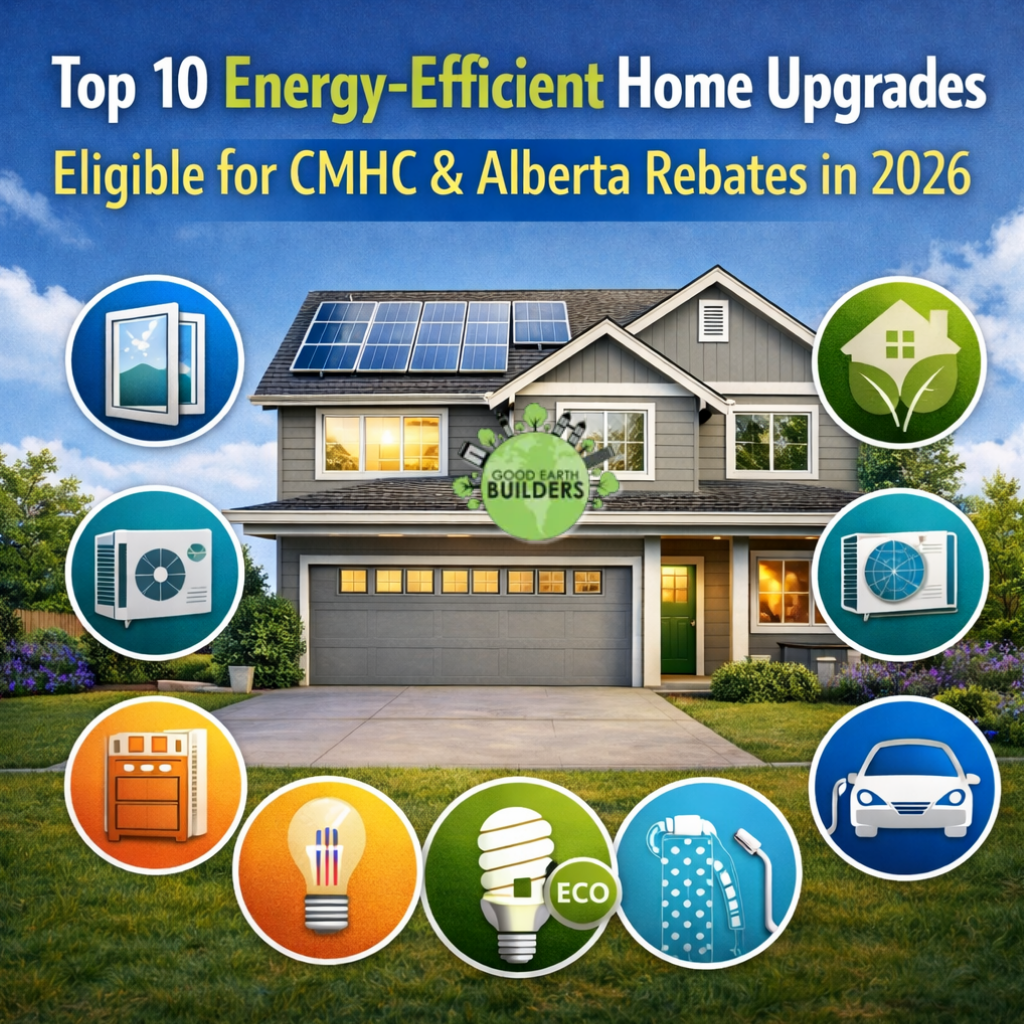
These incentives exist because energy-efficient homes help Canada and Alberta meet ambitious climate goals, reduce strain on the grid, and make housing more affordable over time. In this comprehensive guide, we’ll walk through the top 10 upgrades that qualify for CMHC refunds and Alberta rebates in 2026. For each one, you’ll find:
- What the upgrade actually does
- Typical cost range in Calgary/Alberta (installed)
- Estimated annual energy savings
- Current rebate/refund amounts (as of late 2025–early 2026)
- Why it’s especially valuable in Alberta’s climate
- Pros, cons, and payback period
- Practical installation tips and real homeowner examples
By the end, you’ll have a clear, prioritized plan to start saving money and energy—whether you’re doing one small upgrade or a full home retrofit.
1. Air-Source Heat Pumps (Cold-Climate Models)
Air-source heat pumps are currently one of the most popular and heavily incentivized upgrades in Alberta. These systems work like a reversible air conditioner: in winter they extract heat from the outside air (even when it’s very cold) to warm your home, and in summer they reverse to provide cooling. Modern cold-climate air-source heat pumps are specifically engineered to maintain strong performance down to -25°C or even -30°C, making them reliable for Alberta winters without needing a full gas backup.
Typical Installed Cost: $8,000 – $18,000 (depending on home size, ductwork needs, and model) Estimated Annual Savings: 40–60% on heating bills (often $1,200–$2,500 per year for an average home) Rebates & Incentives (2026): Up to $5,000–$7,000 through provincial heat pump rebates (if extended), ENMAX/ATCO utility rebates, and CEIP financing with 10% incentive. Fully eligible for CMHC Eco Improvement 25% premium refund. Why It’s Top for Alberta: Heating dominates energy use in our climate. Heat pumps cut natural gas dependence, lower emissions, and provide air conditioning—something many older homes lack. They also improve indoor air quality by circulating fresh air without combustion byproducts. Pros: Dual heating/cooling, quiet, long lifespan (15–20 years), qualifies for maximum rebates. Cons: Higher upfront cost than a basic furnace; may need electric backup for extreme cold below -30°C. Payback Period: Usually 5–8 years with rebates and savings. Installation Tips: Always get a professional energy audit first to size the system correctly. Choose a contractor certified for cold-climate installations. If your home has existing ductwork, use a central system; otherwise, ductless mini-splits are excellent for additions or older homes. Real Example: A homeowner in Killarney replaced a 20-year-old gas furnace with a cold-climate heat pump in late 2025. They received $6,200 in rebates and reported $1,800 annual savings on heating, with noticeably better comfort during chinooks and cold snaps.
2. Attic & Wall Insulation Upgrades
Insulation is often called the “lowest-hanging fruit” of home efficiency because it delivers some of the biggest savings for the lowest effort. In many Alberta homes built before 2000, attic insulation is only R-20 to R-30, far below the recommended R-50–R-60 for our climate. Adding blown-in cellulose, fiberglass, or spray foam to attics, exterior walls, and even crawl spaces can make a dramatic difference.
Typical Installed Cost: $2,000 – $8,000 (attic only is usually $2,000–$4,000; full walls + attic $6,000+) Estimated Annual Savings: 15–30% on heating and cooling bills ($600–$1,500/year for average homes) Rebates & Incentives (2026): $1,000–$5,000 through CEIP (up to 10% incentive), ATCO/ENMAX rebates, and full eligibility for CMHC 25% refund. Why It’s Top for Alberta: Poor insulation causes ice dams, frost on windows, and high bills. This upgrade is the foundation for every other efficiency measure—heat pumps, windows, and solar all work better in a well-insulated home. Pros: Fast ROI (3–6 years), minimal disruption (attic-only takes 1 day), huge comfort gain, reduces noise and pests. Cons: Wall insulation requires drilling holes or opening drywall (messier). Payback Period: 3–6 years—often the fastest of all upgrades. Installation Tips: Start with a blower door test during an EnerGuide audit to find air leaks. Use blown-in cellulose for attics (dense and effective), and injected foam for walls. Make sure attic ventilation is adequate to prevent moisture buildup. Real Example: A homeowner in Bowness added blown-in insulation and wall foam in 2025. They saved $1,100 on heating the first winter and received $3,200 in combined rebates and CMHC refund. The home felt noticeably warmer and quieter.
3. ENERGY STAR Triple-Pane Windows & Doors
Windows and doors are often the biggest source of heat loss in a home. Replacing single- or double-pane units with ENERGY STAR-certified triple-pane windows (with low-E coatings and argon/krypton gas fill) dramatically reduces this loss while blocking UV rays that fade furniture.
Typical Installed Cost: $10,000 – $25,000 for a full home (depending on number and size of windows) Estimated Annual Savings: 10–25% on heating and cooling ($400–$1,200/year) Rebates & Incentives (2026): $100–$300 per window/door through CEIP, ENMAX/ATCO rebates, and full CMHC Eco Improvement refund eligibility. Why It’s Top for Alberta: Triple-pane windows handle extreme temperature swings better, reduce condensation, and cut street noise—important in dense infill areas. In hail country, impact-resistant triple-pane options add protection. Pros: Improves curb appeal, security (stronger glass/locks), and comfort; payback 5–10 years. Cons: Higher upfront cost for custom sizes; heavy frames may require structural checks on older homes. Payback Period: 5–10 years, faster with rebates. Installation Tips: Choose vinyl or fiberglass frames for durability in cold climates. Get multiple quotes from certified installers to ensure proper sealing and flashing. Measure carefully for accurate pricing. Real Example: A Mount Pleasant family replaced 12 old windows in 2025, saving $700 annually on energy and receiving $2,400 in rebates plus CMHC refund. The house stayed warmer and quieter, and resale value increased noticeably.
4. Solar Photovoltaic (PV) Panels + Battery Storage
Solar panels generate clean electricity right on your roof, and battery storage (like Tesla Powerwall or Enphase systems) lets you store excess power for evenings, outages, or peak-rate times.
Typical Installed Cost (after incentives): $15,000 – $35,000 for a 6–10 kW system with battery Estimated Annual Savings: $1,000 – $2,500+ through net metering (credits for surplus power sent to the grid) Rebates & Incentives (2026): Up to $5,000–$10,000 through municipal solar programs, CEIP financing, and CMHC Eco Plus/Improvement refund. Why It’s Top for Alberta: Calgary enjoys over 2,300 hours of sunshine annually—among the best in Canada. Solar provides long-term protection against rising electricity rates and adds energy independence. Pros: Clean, renewable power; increases home value (often 3–4% premium); excellent long-term ROI. Cons: Higher upfront cost; roof orientation and shading affect output. Payback Period: 7–12 years with incentives, faster with battery and rising rates. Installation Tips: Get a solar site assessment to confirm roof suitability (south-facing, minimal shade). Use certified installers for warranty and rebate eligibility. Batteries add resilience during outages. Real Example: A homeowner in Arbour Lake installed a 7.8 kW system with battery in 2025, offsetting 85% of their electricity use and receiving $8,200 in rebates. They now sell surplus power back to the grid.
5. High-Efficiency Gas or Electric Furnaces/Boilers
Upgrading to a high-efficiency (96%+ AFUE) gas furnace or condensing boiler ensures more heat from the fuel you use.
Typical Installed Cost: $5,000 – $10,000 Estimated Annual Savings: 10–20% on heating bills Rebates & Incentives (2026): $500–$2,000 from utility programs; CMHC Eco Improvement eligible. Why It’s Top for Alberta: Reliable backup for heat pumps in extreme cold; quick install with existing ducts. Pros: Lower operating costs; smart thermostats add control. Cons: Still uses fossil fuels (unless electric). Payback Period: 5–8 years. Installation Tips: Pair with ECM motor and zoning for extra savings.
6. Heat Pump Water Heater
Replaces conventional water heaters with an efficient model that pulls heat from surrounding air.
Typical Installed Cost: $3,000 – $6,000 Estimated Annual Savings: 50–70% on water heating Rebates & Incentives (2026): $500–$1,500 (Alberta/utility); CMHC qualifying. Why It’s Top: High ROI; reduces electricity/gas use. Pros: Low operating cost. Cons: Needs space and ventilation. Payback Period: 4–6 years.
7. HRV/ERV Ventilation Systems
Heat/energy recovery ventilators exchange stale indoor air with fresh outdoor air while recovering most of the heat.
Typical Installed Cost: $3,000 – $7,000 Estimated Annual Savings: 10–20% on HVAC energy Rebates & Incentives (2026): $500–$1,500; CMHC eligible. Why It’s Top: Improves indoor air quality in tight homes. Pros: Reduces humidity, mold risk. Cons: Regular filter changes. Payback Period: 6–10 years.
8. Basement Insulation & Waterproofing
Insulate basement walls/floors and add waterproofing for efficiency and moisture control.
Typical Installed Cost: $5,000 – $15,000 Estimated Annual Savings: 15–25% on heating Rebates & Incentives (2026): $1,000–$4,000; CMHC qualifying. Why It’s Top: Creates usable space; flood protection. Pros: Bonus living area. Cons: Disruptive during install. Payback Period: 5–8 years.
9. Smart Home Energy Management Systems
Smart thermostats, lighting, plugs, and whole-home energy monitors automate and optimize energy use.
Typical Installed Cost: $500 – $2,500 Estimated Annual Savings: 5–15% overall Rebates & Incentives (2026): $100–$500 (utility); CMHC bundled. Why It’s Top: Low cost, easy add-on. Pros: Convenience, usage insights. Cons: Tech learning curve. Payback Period: 2–5 years.
10. Geothermal Heat Pumps (Ground-Source)
Use stable ground temperature for heating/cooling via buried loops.
Typical Installed Cost: $25,000 – $50,000 Estimated Annual Savings: 60–80% on HVAC Rebates & Incentives (2026): Up to $10,000+ (federal/provincial); CMHC maximum refund. Why It’s Top: Highest long-term efficiency. Pros: 20–30 year lifespan. Cons: High upfront cost, excavation needed. Payback Period: 8–15 years.
Bonus Tips to Maximize Your Savings in 2026
- Start with a Professional EnerGuide Audit (~$300–$600): Identifies priorities and maximizes rebate eligibility.
- Stack Incentives Wisely: Combine CMHC refund + CEIP financing + utility rebates for the biggest total savings.
- Hire Certified Contractors: NRCan-registered pros ensure compliance and quality.
- Keep Records: Save all invoices and reports for rebate applications.
- Monitor Program Updates: Check cmhc-schl.gc.ca and alberta.ca early in 2026 for any changes.
- Consider Long-Term Value: Many upgrades increase resale value by 3–7% and qualify for green mortgage rates.
These 10 upgrades offer some of the best returns available in 2026, with payback periods typically between 3–10 years when incentives are applied. Whether you start small with insulation or go all-in with solar and heat pumps, the combination of CMHC refunds, provincial rebates, and lower utility bills makes this a financially and environmentally smart time to upgrade your home.
If you’re planning a major energy-efficient renovation or new build in Calgary, working with experienced local builders who understand these programs can make the process much easier. Good Earth Builders, with over 23 years of experience in the city and 846 completed projects, specializes in sustainable, high-efficiency homes and renovations. Their commitment to planting 10 trees for every job adds an extra layer of environmental responsibility. Reach out to them for a free consultation to see how these upgrades can fit your home and help you maximize your 2026 rebates and savings.