Friday, January 23, 2026
Calgary’s real estate market is one of the most dynamic in Canada, and infill development is at the heart of it. As the city grows—adding over 110,000 new residents between 2023 and 2028—demand for housing in mature neighborhoods like Bowness, Killarney, Highland Park, and Tuxedo Park is stronger than ever. Infill means tearing down older single-family homes and building denser options on the same lot, such as duplexes, row homes, or small multi-family units like 4-plexes. This approach uses existing infrastructure, reduces urban sprawl, and creates walkable communities close to schools, transit, and amenities.
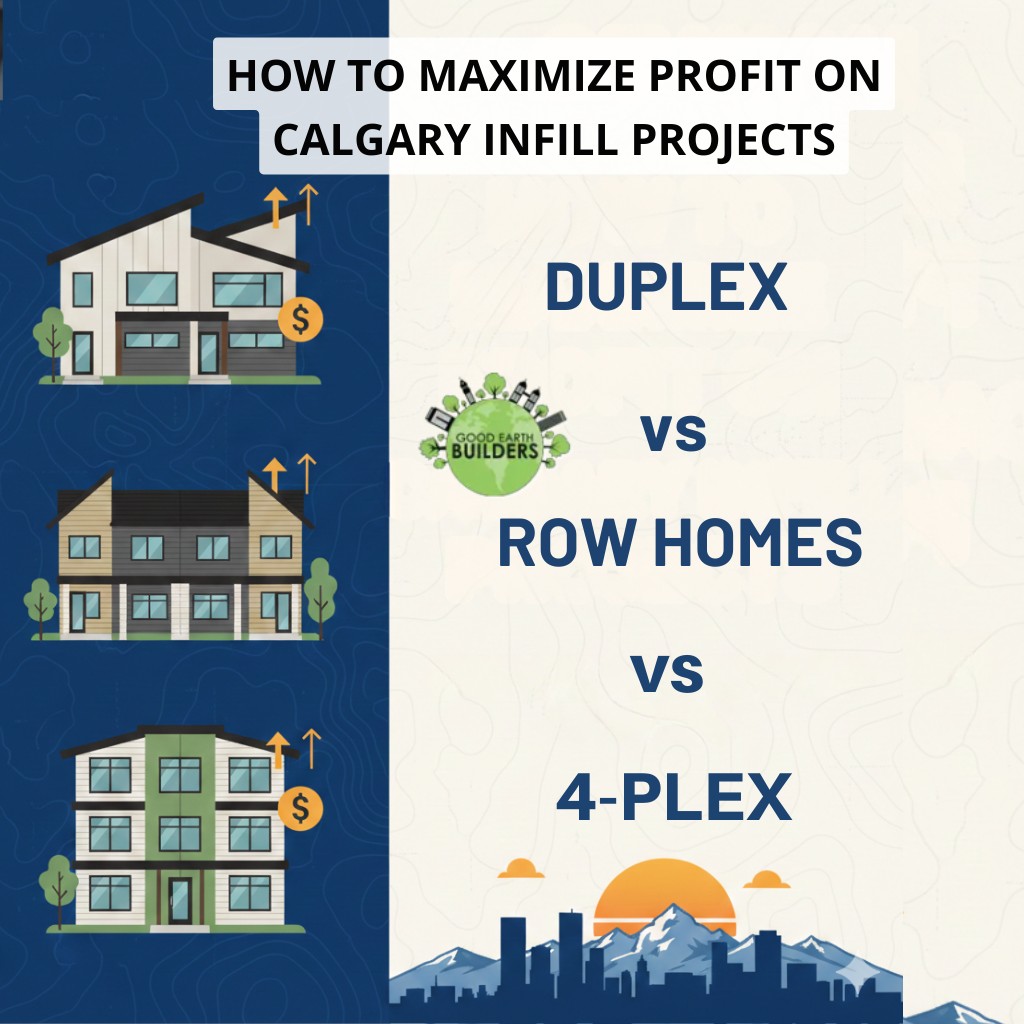
For developers, investors, and even homeowners looking to subdivide, infill projects can be highly profitable. However, with construction costs stabilizing but still elevated (projected 2-4% increases in 2026 due to modest inflation), choosing the right type of build is key to maximizing returns. The three most popular options—duplex (two units), row homes (3-6 attached townhomes), and 4-plex (four units, often with basement suites)—each have unique costs, revenue potential, risks, and incentives. Duplexes offer quick flips with low risk, row homes provide balanced scale, and 4-plexes deliver the highest long-term yields for rental strategies.
In 2026, Calgary’s market favors infill: Housing starts lead per capita in Canada, rental vacancy is around 4-6%, and programs like the Infill Fast Track streamline permits for compliant designs. CMHC incentives (up to 25% mortgage premium refunds for energy-efficient features) and CEIP rebates (up to 10% on sustainable upgrades) can further boost profits. This guide compares the three types in detail, including costs, profit margins, examples, pros/cons, and tips to maximize ROI. By the end, you’ll have a clear understanding of which option fits your goals—whether fast cash from sales or steady income from rentals—and how to navigate 2026’s opportunities.
Quick Comparison Table: Duplex vs Row Homes vs 4-Plex in Calgary 2026
To give you a snapshot before diving in, here’s a comparison based on average 2026 data for Calgary infill projects. Costs include land, construction, and soft expenses; profits assume market-rate sales or rentals.
| Infill Type | Typical Lot Size | Number of Units | Average Build Cost | Average Sale Price per Unit | Gross Profit Margin | Rental Yield (Annual) | Best For | Risk Level | Timeline (Months) |
|---|---|---|---|---|---|---|---|---|---|
| Duplex | 50×120 ft | 2 | $550,000–$750,000 | $550,000–$750,000 | 18–28% | 5–7% | Beginners, quick flips | Low | 4–8 |
| Row Homes | 100–150 ft wide | 3–6 | $1.2M–$2.5M | $450,000–$650,000 | 20–32% | 6–8% | Mid-size developers, balance | Medium | 6–12 |
| 4-Plex | 50–75 ft wide | 4 | $1.0M–$1.8M | $400,000–$550,000 | 22–35% | 7–9% | Rental investors, high yield | Medium-High | 8–14 |
Note: Costs are estimates based on stabilizing 2026 prices (2-4% inflation); actuals vary by location, finishes, and market conditions. Rental yields assume 80-90% occupancy.
1. Duplex – The Safest, Fastest Path to Profit
A duplex is the entry-level infill project: One lot divided into two units, often with one above-ground home and a legal basement suite, or side-by-side semi-detached homes. It’s popular in Calgary because it’s straightforward, requires less capital, and sells quickly to families or investors.
Typical Costs for Duplex Infill in Calgary 2026
- Land Acquisition: $400,000–$600,000 for a standard 50×120 ft lot in mature areas (lower in suburbs like Ogden, higher in inner-city like Mount Pleasant).
- Demolition and Site Prep: $20,000–$50,000 (including asbestos checks and utility disconnects).
- Construction: $150,000–$200,000 per unit (framing, plumbing, electrical, finishes; total $300,000–$400,000). Use prefab for 10-15% savings.
- Soft Costs: $80,000–$150,000 (permits, engineering, financing interest, marketing). Calgary’s Infill Fast Track can cut permit times by 50%, saving $10,000–$20,000 in holding costs.
- Total Project Cost: $550,000–$750,000.
Revenue and Profit Potential
- Sale Price: $550,000–$750,000 per unit (total $1.1M–$1.5M). Premium for energy-efficient features like heat pumps (add 3-5% value).
- Gross Profit Margin: 18–28% after all costs ($150,000–$300,000 net profit).
- Rental Income (If Holding): $2,500–$3,000 per unit monthly ($5,000–$6,000 total) → 5–7% yield after expenses. Legal suites boost this by 20-30%.
Why Duplexes Maximize Profit for Beginners
Duplexes offer low entry barriers and quick turnarounds. With Calgary’s median home price over $500,000, these appeal to first-time buyers or investors seeking rental income. Profit comes from land value uplift—buy a teardown lot for $450,000, build for $400,000, sell for $1.3M. Incentives like CMHC Eco refunds (25% on premiums for green upgrades) and CEIP rebates (10% on solar/insulation) can add $10,000–$30,000 in savings.
Best Neighborhoods and Strategies
- High-Profit Areas: Bowness, Killarney, Highland Park—strong family demand, good schools/transit. Avoid flood zones (higher insurance/retrofit costs).
- Maximization Tips: Use prefab modules for 20% faster builds; add legal suites for dual rental streams; incorporate energy features for rebates.
Real-World Example
In 2025, a developer in Tuxedo Park bought a $500,000 lot, demolished the old bungalow, and built a side-by-side duplex with basement suites for $650,000 total cost. Sold both units for $1.4M in early 2026—net profit of $250,000 (28% margin) after fees. Rental option would yield $6,000/month.
Pros, Cons, and Risks
Pros: Low risk, easy financing (banks favor duplexes), fast sales (3-6 months on market). Cons: Lower total profit per project than larger infill; zoning limits in some areas. Risks: Market slowdown could delay sales, but duplexes are resilient due to family demand. Mitigate with green upgrades for premium pricing.
Duplexes are ideal for developers testing the waters or seeking consistent, moderate returns.
2. Row Homes – Balanced Scale for Higher Total Profits
Row homes, or townhomes, involve 3-6 attached units on wider lots or multiple parcels, sharing walls for efficiency. They’re popular in Calgary for providing affordable ownership without condo fees.
Typical Costs for Row Home Infill in Calgary 2026
- Land Acquisition: $600,000–$1.2M (wider 100-150 ft lots or adjacent parcels).
- Demolition and Site Prep: $50,000–$100,000 (multiple structures).
- Construction: $1.2M–$2.5M ($300,000–$450,000 per unit, savings from shared walls). Prefab can reduce by 15%.
- Soft Costs: $150,000–$400,000 (higher for multi-unit permits). Infill Fast Track saves time/costs.
- Total Project Cost: $1.2M–$2.5M.
Revenue and Profit Potential
- Sale Price: $450,000–$650,000 per unit (total $1.8M–$3.9M for 4-6 units).
- Gross Profit Margin: 20–32% ($400,000–$800,000 net).
- Rental Income (If Holding): $2,500–$3,500 per unit ($10,000–$21,000 total/month) → 6–8% yield.
Why Row Homes Maximize Profit for Mid-Size Developers
Higher density means more units per lot, spreading land costs and increasing total revenue. Economies of scale kick in—bulk materials, shared utilities save 10-15% per unit. In 2026, with stabilizing costs, row homes benefit from CEIP rebates on green features and CMHC financing for multi-family. Profit from sales or rentals, with strong demand for family-sized townhomes.
Best Neighborhoods and Strategies
- High-Profit Areas: Forest Lawn, Ogden, Radisson Heights—lower land costs, good appreciation.
- Maximization Tips: Strata-title for individual sales; add suites for extra income; use prefab for speed.
Real-World Example
A 2025 project in Glamorgan built 5 row homes on a $800,000 lot for $2.0M total cost. Sold at $550,000 each for $2.75M—net profit $550,000 (27% margin). Rental would yield 7.2%.
Pros, Cons, and Risks
Pros: Higher total profit, good cash flow if renting. Cons: Longer timelines, more neighbors to manage during build. Risks: Zoning appeals; mitigate with community consultation.
Row homes offer a step up in scale for developers ready to handle multi-unit complexity.
3. 4-Plex – Highest Yield for Rental Investors
A 4-plex is a small multi-family building with four units (often two up/two down, with basements), on a standard lot. It’s zoned for higher density in many Calgary areas.
Typical Costs for 4-Plex Infill in Calgary 2026
- Land Acquisition: $450,000–$750,000 (50-75 ft lots).
- Demolition and Site Prep: $40,000–$80,000.
- Construction: $1.0M–$1.8M ($250,000–$450,000 per unit).
- Soft Costs: $150,000–$300,000 (higher permitting).
- Total Project Cost: $1.0M–$1.8M.
Revenue and Profit Potential
- Sale Price: $400,000–$550,000 per unit (total $1.6M–$2.2M if strata).
- Gross Profit Margin: 22–35% ($300,000–$700,000 net).
- Rental Income: $2,200–$3,200 per unit ($8,800–$12,800/month) → 7–9% yield.
Why 4-Plexes Maximize Profit for Rental-Focused Developers
Highest density per lot maximizes revenue; strong rental demand in Calgary (vacancy 4-6%) ensures occupancy. In 2026, CMHC rental financing (low rates for multi-family) and provincial affordable housing grants (up to $100,000/unit if including affordable) add value. Hold for cash flow or sell as income properties.
Best Neighborhoods and Strategies
- High-Profit Areas: Highland Park, Glamorgan—good transit, rental demand.
- Maximization Tips: Add legal suites for 8 units; use prefab for speed.
Real-World Example
A 2025 4-plex in Radisson Heights cost $1.3M, renting at $2,800/unit ($11,200/month). Yield 8.3% after expenses; resale as income property at $2.0M netted $400,000 profit.
Pros, Cons, and Risks
Pros: Highest yield, stable income. Cons: More management if renting. Risks: Longer lease-up; mitigate with market research.
4-plexes suit investors with capital for higher returns.
Final Comparison: Which Infill Type Maximizes Profit in 2026?
- Duplex: Safest for quick, low-risk profit.
- Row Homes: Balanced for mid-scale gains.
- 4-Plex: Highest for rental-focused, long-term profit.
Factors: Land cost (higher favors density), financing (duplex easiest), market (rentals strong).
Tips to Maximize Profit on Any Calgary Infill Project in 2026
- Prefab for 10-20% savings.
- Local sourcing for transport cuts.
- Green upgrades for CMHC refunds.
- Fast Track for permits.
- Mixed-income for grants.
- Pro formas with contingencies.
Challenges and Risks in 2026
Challenges: Rising costs (2-4%), zoning appeals, delays. Risks: Market slowdowns, overbuilding.
Solutions: Diversify types, partner for expertise, use incentives.
Outlook for 2026: A Strong Year for Calgary Infill
With stabilizing costs and demand, 2026 favors infill. Higher density (row/4-plex) wins for max profit.
Infill offers great opportunities—choose wisely for success.
For developers exploring these, experienced local builders can optimize. Good Earth Builders, with over 23 years in Calgary and 846 projects, specializes in profitable infill like duplexes and row homes. Their tree-planting commitment adds value. Contact for consultation.