Friday, February 20, 2026
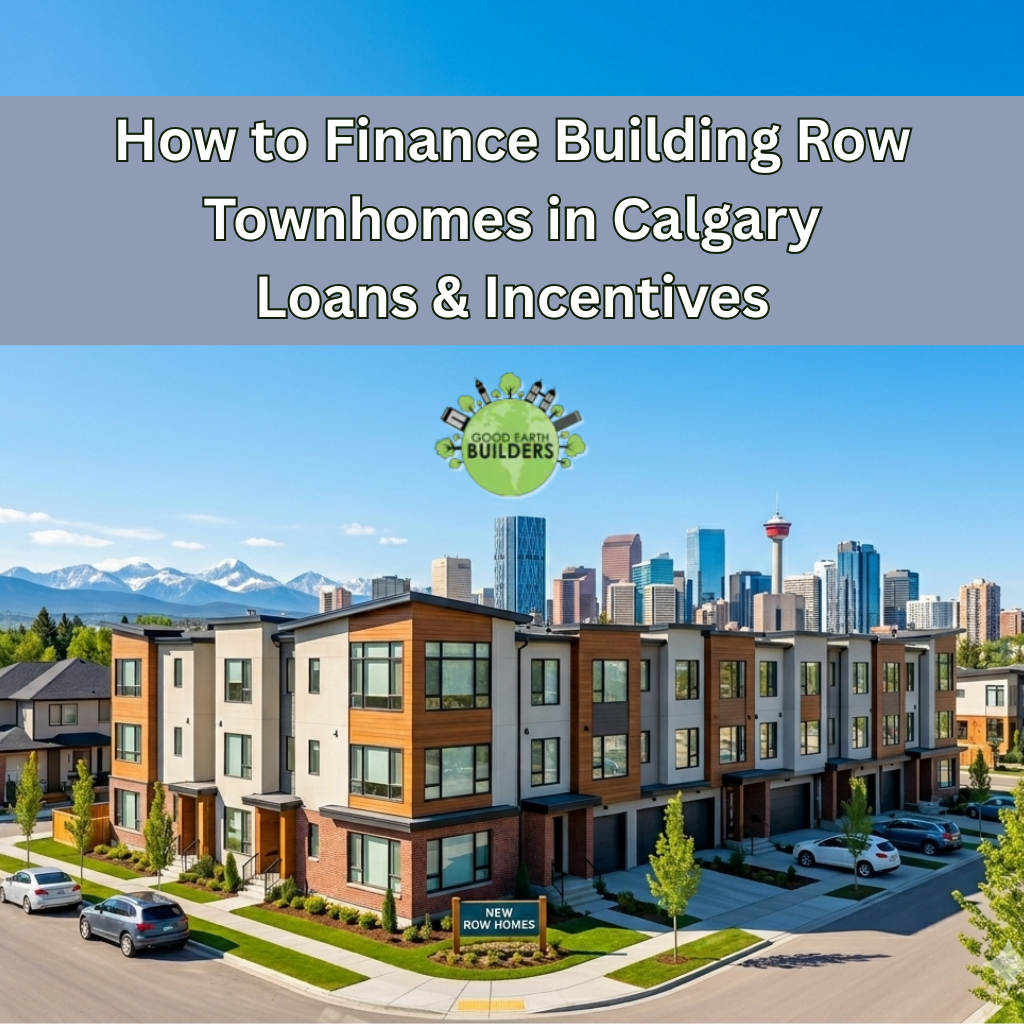
Building row townhomes—attached multi-unit homes typically in rows of 3-8 on a single or combined lot—is one of the most popular and profitable infill strategies in Calgary. These developments add density to mature neighborhoods like Forest Lawn, Highland Park, or Killarney, providing affordable ownership or rental options without the complexity of larger apartments. In 2026, with Calgary’s population growth slowing but still strong (adding thousands annually), and a housing market stabilizing after 2025’s inventory surge (sales down 13.6% but prices holding firm), row townhomes offer high rental yields (6-8%) and resale margins (20-32%).
However, financing is often the biggest hurdle. Land costs $600,000-$1.2 million, construction runs $1.2M-$2.5M for 4-6 units, and soft costs add another $150,000-$400,000—totaling $1.2M-$2.5M per project. With construction inflation at 2-4%, developers need smart financing to maximize profits. The good news? A mix of traditional loans, government incentives, rebates, and grants can reduce effective costs by 10-30%, making projects more feasible.
This detailed guide explains how to finance row townhomes in Calgary for 2026. We’ll cover traditional bank loans, specialized financing from ATB and credit unions, CMHC refunds, CEIP rebates, provincial and city grants, GST rebates, how to stack them for maximum savings, application tips, real-world examples, common challenges with solutions, and the outlook for the year. By the end, you’ll have a clear roadmap to secure funding, lower risks, and boost ROI—whether you’re a first-time developer or scaling up infill investments.
Understanding Row Townhomes and Why Finance Them in 2026
Row townhomes are a form of attached housing where units share walls but have individual entrances and small yards, often built on wider lots (100-150 ft) in infill areas. They’re popular in Calgary because they offer family-sized spaces without condo fees, appealing to buyers and renters. Typical projects have 3-6 units, with options for legal basement suites to increase density to 6-12 rentals.
Financing is key in 2026 because:
- Market Conditions: Sales are stabilizing, but inventory is up 28%, creating opportunities for new supply. Rental demand remains high with vacancy at 4-6%.
- Cost Stability: Materials like lumber are flat, labor markets softening (unemployment 4.7%), reducing overruns.
- Incentives Abound: Government programs prioritize multi-family infill to meet housing goals, offering rebates and low-cost capital.
- Profit Potential: Row townhomes can yield 20-32% margins on flips or 6-8% on rentals, but good financing lowers interest and speeds ROI.
Without proper financing, high upfront costs (land, demos) can tie up capital. Let’s explore options.
Traditional Bank Loans for Row Townhomes
Traditional loans from major banks are the foundation for most projects.
1. Construction Loans from Big Banks (RBC, TD, Scotiabank)
Short-term loans (12-24 months) to cover building costs, converting to a mortgage upon completion.
- Typical Terms: 70-80% loan-to-value (LTV), interest 5-7% (prime +1-2%), draw schedule based on milestones.
- Eligibility: Good credit, 20-30% equity, detailed pro forma showing 1.2-1.5x debt coverage.
- Best For: Experienced developers with strong financials.
- Application Tips: Prepare plans, budgets, appraisals. Use online portals like RBC Construction Loans.
- Pros: Competitive rates, large amounts ($1M+).
- Cons: Strict underwriting, personal guarantees.
- Real Example: A 2025 row townhome project in Ogden used RBC financing for 75% LTV, converting to a rental mortgage at completion.
2. Commercial Mortgages for Hold Strategies
Long-term loans (20-30 years) for completed projects.
- Terms: 60-75% LTV, rates 4.5-6.5%.
- Eligibility: Proven rental income.
Banks favor multi-unit like row townhomes for stable cash flow.
Specialized Financing for Row Townhomes
1. ATB Financial Loans
Alberta Treasury Branches (ATB) offers tailored loans for local developers.
- Terms: Construction loans with flexible draws, rates 5-7%.
- Eligibility: Alberta-based projects.
- Best For: Infill with affordable components.
- **Application: ATB Developer Loans.
- Pros: Local knowledge, faster approvals.
- Real Example: ATB financed a 2025 row townhome in Highland Park.
2. Credit Union Loans (Servus, Connect First)
Community-focused lenders with competitive terms.
- Terms: 70-80% LTV, rates 5-6.5%.
- Eligibility: Good credit.
- Pros: Flexible for smaller developers.
CMHC Refunds & Incentives for Row Townhomes
CMHC offers refunds for green upgrades.
CMHC Eco Improvement Refund
- Amount: 25% on premiums for $20,000+ energy upgrades.
- Eligibility: CMHC-insured mortgage.
- Best For: Adding heat pumps/insulation.
- **Application: CMHC Eco.
- Pros: Thousands back.
- Real Example: 2025 row townhome got $4,000 refund.
CMHC Affordable Housing Fund
- Amount: $50,000-$200,000/unit grants/loans for affordable.
- Eligibility: 20% affordable units.
- Pros: Forgivable portions.
CEIP Rebates for Row Townhomes
CEIP finances green upgrades with 10% rebates.
- Amount: Up to 10% ($5,000-$25,000 for row project).
- Eligibility: Energy upgrades.
- **Application: Calgary CEIP.
- Pros: No upfront cash.
- Real Example: 2025 row townhome saved $15,000 on solar.
Provincial & City Grants for Row Townhomes
Alberta Affordable Housing Partnership
- Amount: Up to $100,000/unit for affordable.
- Eligibility: Below-market rents.
- **Application: Alberta Housing.
City of Calgary DIP
- Amount: $75/sq ft for conversions with affordable.
- Eligibility: Infill with 10-30% affordable.
GST Rebate for Row Townhomes
- Amount: 5% back on new builds.
- Eligibility: Under $450,000/unit.
Stacking Incentives for Maximum Savings
Stack for 20-40% savings: CMHC refund + CEIP rebate + grants + GST.
Example: $2M row project gets $200K CMHC + $100K CEIP + $300K grants = $600K savings.
Tips: Audit first, use certified contractors.
Application Process and Tips
- Audit/pro forma.
- Apply for loans.
- Submit for incentives.
- Build.
- Claim refunds.
Tips: Pre-approve, stack, document.
Real-World Examples
- 2025 Ogden: $2M cost, $500K incentives, 25% margin.
- Highland Park: Rental 8-unit row with grants.
Challenges and Solutions
Challenges: Delays, eligibility. Solutions: Consultants, early planning.
Why 2026 Is One of the Best Years to Finance and Build Row Townhomes in Calgary
When you look at everything we’ve covered — the stabilizing construction costs, the softening labor market, the continued population growth, the strong rental demand in mature neighborhoods, and especially the generous stack of financing options and incentives still available in 2026 — one thing becomes very clear: this is an unusually favorable window to finance and build row townhomes in Calgary.
These incentives aren’t temporary or one-year programs that might disappear tomorrow. Traditional bank loans from RBC, TD, Scotiabank, and others remain accessible with competitive rates and flexible draw schedules. ATB Financial and credit unions like Servus continue to offer tailored, Alberta-focused financing that understands the local infill market. CMHC’s Eco Improvement refund (up to 25% back on mortgage premiums for energy-efficient upgrades), the City of Calgary’s Clean Energy Improvement Program (CEIP) with its 10% rebate on qualifying work, the GST/HST rebate for new builds, and the Downtown Development Incentive Program (DIP) with its $75 per square foot for qualifying projects are all part of long-term strategies to increase housing supply, promote sustainability, and help developers and investors deliver more units profitably. And in 2026, these programs are still fully funded, active, and open to new applicants — with no major cuts announced yet.
On top of that, the broader market conditions feel right. Material prices have largely leveled off after the wild swings of 2021–2024 — lumber is flat or only modestly up, steel and concrete costs are predictable, and labor availability is improving slightly with unemployment ticking up to around 4.7%. Interest rates remain in a range that still supports well-structured financing, especially when you combine low-cost CMHC loans with CEIP’s tax-bill repayment model. All of this means your net out-of-pocket cost to finance and build a row townhome project can be 10–30% lower than it would have been a few years ago — and that’s before factoring in the long-term savings from lower utility bills, higher rental income, and increased property value.
The real power comes when you stack these financing options and incentives properly. A $2 million row townhome project could realistically see:
- $50,000–$150,000 in interest savings from low-cost construction loans and ATB financing
- $20,000–$50,000 back from CMHC premium refunds on energy upgrades
- $50,000–$150,000 in CEIP rebates and financing incentives for solar, heat pumps, or insulation
- Additional savings from GST rebates and potential development charge waivers
That’s potentially $150,000–$400,000+ in direct financial support — money that goes straight to your bottom line, lets you upgrade to higher-quality finishes, or allows you to take on a slightly larger project without increasing your equity requirement.
But beyond the dollars, row townhomes in 2026 are also one of the most flexible and future-proof investments you can make in Calgary right now. You can build to sell for quick capital gains — strata-title the units individually and flip them at $450,000–$650,000 each in strong neighborhoods. You can hold the entire building for long-term cash flow, collecting $10,000–$21,000 per month in gross rents with yields of 6–8% after expenses. Or you can do a hybrid: sell 70–80% to recoup most of your capital and keep 1–2 for ongoing income. You can add legal basement suites to boost rent or resale value. You can incorporate green features like heat pumps, better insulation, or solar-ready roofs to unlock extra rebates and attract eco-conscious tenants or buyers willing to pay a premium. You can even go mixed-income — include a couple of units at below-market rents to qualify for deeper provincial or federal grants — and still keep healthy overall margins.
In short, row townhomes give you options. They let you adapt to whatever the market does in 2026 — whether it’s a hot seller’s market, a shift toward more rental demand, a sudden increase in interest from institutional buyers looking for small multi-family assets, or even a temporary slowdown that makes holding for cash flow more attractive.
The market timing feels right too. Rental demand is expected to tighten again as new purpose-built rentals take time to come online. Property values in mature neighborhoods continue to rise steadily. And buyers and renters are increasingly looking for energy-efficient, resilient homes — features that qualify for the very incentives we’ve discussed. A well-built row townhome project with modern, efficient units doesn’t just generate strong cash flow or resale profits; it becomes a selling point if you ever decide to exit or refinance.
Of course, no project is risk-free. Permitting can still take time (even with Fast Track), costs can creep up if you don’t lock in quotes early, and you’ll need to plan carefully to meet zoning, setback, and parking rules. But row townhomes have built-in buffers: lower per-unit risk than larger buildings, faster lease-up than single-family rentals in many areas, strong underlying demand in Calgary’s core neighborhoods, and access to multiple layers of government support that reduce your downside.
When you combine the financial math (strong yields, solid margins, incentive stacking), the market timing (stabilizing costs, continued population growth, tight rental fundamentals), and the flexibility (sell, hold, hybrid), row townhomes emerge as one of the most intelligent and high-upside plays in Calgary’s infill landscape right now.
If you’re a developer or investor seriously considering your next move in Calgary real estate, ask yourself: Why limit yourself to one or two units per lot when you can build a row of them — and multiply your returns without multiplying the risk exponentially?
The opportunity is real. The financing options are still accessible. The incentives are still generous. The demand is still there. And the long-term upside — both financial and lifestyle — is hard to ignore.
If you’re ready to turn that opportunity into reality, working with experienced local builders who understand Calgary’s infill rules, zoning quirks, incentive landscape, and the realities of building attached multi-family projects can make all the difference between a smooth, profitable project and one full of surprises.
Good Earth Builders, with over 23 years of experience in the Calgary market and 846 completed projects, has built hundreds of successful infill developments — including many row townhome communities. They specialize in efficient, high-quality multi-family and attached housing, and they’re known for helping developers navigate permits, maximize incentives, and deliver projects on time and on budget. Their commitment to planting 10 trees for every job also adds real environmental value to each development.
If you’re thinking about financing and building row townhomes in 2026 and want expert guidance on loans, incentives, design, costs, and timelines, reaching out to a team like Good Earth Builders can help you get started with confidence, clarity, and a realistic plan to maximize your savings and returns.