
Monday, December 08, 2025
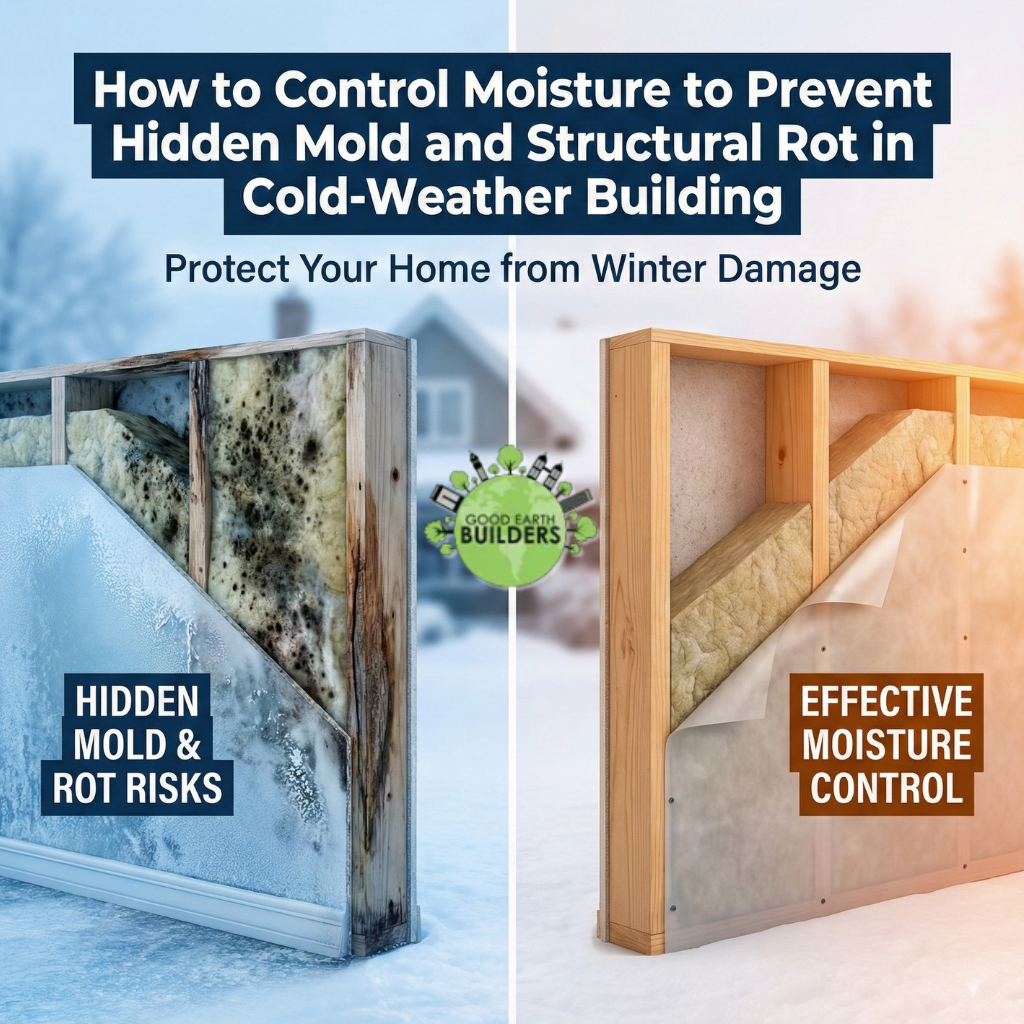
The period when a construction project transitions from an open frame to a sealed, heated structure is the most perilous for the long-term health of the home. In cold climates, the building envelope often becomes a dangerous condensation chamber, hosting the perfect conditions for mold, mildew, and structural rot—a phenomenon known as the Winter Paradox.
The root cause is straightforward: warm, moisture-laden air (from heaters, concrete, and materials) meets cold surfaces (framing, sheathing, foundation), causing saturation. This hidden moisture is subsequently trapped behind the vapor barrier and drywall, leading to catastrophic concealed damage that may not surface for years, resulting in massive warranty claims and occupant health issues.
This comprehensive guide is designed for builders who prioritize technical excellence and longevity. It moves beyond simple venting, providing an advanced, four-phase protocol involving material science, digital monitoring, and diagnostic testing to guarantee the entire building envelope is dry, stable, and protected throughout the cold-weather construction cycle.
I. Introduction: The High Stakes of Concealed Condensation
Condensation on a window is visible; condensation inside a wall assembly is a disaster. It is the hidden water that poses the greatest threat.
A. The Winter Paradox: Why Heat is the Problem
In the summer, materials dry quickly through natural airflow. In the winter, the builder deliberately seals the home and introduces heat, creating a high-pressure, high-humidity interior environment.
- The Prime Suspects: The primary sources of this high humidity are the hydration of fresh concrete (releasing water vapor) and the massive amount of water vapor released by unvented combustion heaters (releasing nearly $1 \text{ liter}$ of water per $1 \text{ liter}$ of fuel burned).
- The Failure Point: This warm, humid air tries to escape through tiny holes, gaps, and imperfect seals in the building envelope (air leaks). When this moisture-rich air encounters the cold sheathing or framing near the exterior, it instantly cools, hits the Dew Point, and deposits water as condensation within the wall cavity.
B. The Resulting Structural and Health Catastrophe
If wood framing or sheathing remains above $20\%$ moisture content for just 48 hours, the cellulose fibers become available for mold colonies. If this condition persists, the consequences are severe:
- Structural Rot: Prolonged moisture exposure leads to rot (decay), permanently reducing the structural strength of framing members and trusses.
- Compromised Insulation: Wet insulation loses its R-value, destroying the home’s energy efficiency and leading to higher utility bills.
- Health Hazards: Mold hidden in wall cavities releases spores and mycotoxins into the living space, causing respiratory issues and potential litigation.
II. Phase 1: Material Science and Source Elimination
Controlling moisture starts before the materials even enter the building envelope.
A. The Absolute Ban on Unvented Heating
The use of unvented, direct-fired heaters is incompatible with high-quality winter construction. They are, quite simply, a deliberate introduction of gallons of water vapor directly into a sealed structure.
- Mandatory Protocol: Only use indirect-fired heaters where the combustion air is vented separately to the exterior, ensuring that only dry, clean, heated air enters the home. Electric heaters are also a clean option, though often cost-prohibitive for large-scale drying.
- Fuel Storage: Ensure fuel (propane, diesel) and solvents are stored outside the envelope to minimize VOC (Volatile Organic Compound) contamination of the interior air and materials.
B. Controlling Hydration Moisture and Hygroscopic Materials
The materials used in construction act as giant sponges, absorbing and releasing moisture based on ambient conditions—a process known as moisture buffering.
- Concrete Off-Gassing: Allow newly poured concrete slabs and foundation walls a substantial, documented period to dry. This phase is critical. Use moisture meters designed for concrete (which measure relative humidity deep within the slab) to confirm drying before installing wood framing directly onto concrete or sealing the basement wall with drywall.
- Lumber Moisture Content Verification: Before installing expensive finishes, wood flooring, or even closing up the walls with drywall, every load of framing lumber, engineered wood, and sheathing should be tested with a pin-type moisture meter. Wood should ideally be at or below $19\%$ moisture content. Closing wet wood inside a wall cavity guarantees that, as it dries, it will feed moisture into the air and likely warp or shrink, damaging the drywall finish.
C. Temporary Insulation (The Interior Warm Zone)
The goal is to prevent condensation on the sheathing by ensuring the air never meets a cold surface.
- Interior Thermal Break: Install temporary interior rigid foam insulation (XPS) or heavy insulation blankets on the interior side of the exterior wall assembly. This keeps the wall structure warmer than the interior air’s dew point, pushing the point of condensation to the outside of the sheathing, where it can harmlessly evaporate (or at least be managed).
III. Phase 2: Strategic Ventilation, Dehumidification, and Air Barriers
Once the major water sources are eliminated, a disciplined protocol of air exchange and water removal is implemented.
A. Ventilation vs. Mechanical Dehumidification (The Efficiency Trade-Off)
- Ventilation (Air Exchange): Opening windows or using exhaust fans removes saturated air, but also removes the expensive heated air, requiring massive energy consumption. It is necessary during high-moisture activities (painting, mudding).
- Requirement: Exhaust fans must be powerful enough to achieve a controlled Air Change per Hour (ACH) rate, ensuring continuous airflow.
- Mechanical Dehumidification (Efficiency): Commercial-grade refrigerant dehumidifiers are often more economical during long periods. They actively condense water vapor, reducing the Relative Humidity (RH) of the air without venting the expensive heat outdoors.
- Placement: Dehumidifiers must be placed with strategic airflow patterns to draw air across the wettest surfaces (e.g., new concrete) and must be constantly monitored to ensure the collected water is draining safely away from the foundation.
B. Understanding Air Barriers vs. Vapor Retarders
These two components are often confused, but their correct placement is the ultimate defense against concealed moisture.
- Air Barrier (The Seal): Prevents the bulk movement of air (and the moisture it carries) through the envelope. A continuous, perfectly sealed air barrier is the primary defense against condensation in a cold climate. In Canada, this is often the interior polyethylene sheeting, but it can also be exterior sheathing taped and sealed.
- Vapor Retarder (The Slowdown): Controls the diffusion of water vapor through materials (like drywall or insulation). For Calgary’s climate, the vapor barrier must be placed on the warm-in-winter side of the insulation (the interior side) to stop vapor from diffusing into the cold cavity where it would condense.
- The Protocol: High-performance builders conduct the Blower Door Test before the drywall stage to measure the actual air tightness of the structure (measured in ACH). Locating and sealing air leaks at this stage is far cheaper than fixing mold later. This test provides objective, verifiable data on the air barrier’s integrity.
IV. Phase 3: Advanced Monitoring and Data Logging 🌡️
Reliance on visual inspection or single-point thermometer readings is insufficient. A professional must document the envelope’s performance over time.
A. Monitoring the Dew Point (The Critical Metric)
The dew point is the single most important metric for preventing condensation.
- Thermo-Hygrometers: Use instruments to constantly monitor the interior air temperature and Relative Humidity (RH). The target should be to maintain the RH below $50\%$ during the drying process.
- Data Loggers: For maximum diligence, install small, inexpensive, battery-powered data loggers in high-risk, concealed locations (e.g., inside the ceiling assembly, near cold window frames, or in the sub-floor cavity). These loggers record temperature and RH every hour, providing a continuous, verifiable record that the envelope was kept dry throughout the crucial construction phases. This documented proof is invaluable for warranty purposes.
B. Final Dry-Out and System Activation
The final stages involve transitioning the home to its permanent mechanical systems.
- Drying Target: The project is only ready for the final finishes when the Equilibrium Moisture Content (EMC) of the framing lumber matches the long-term expected interior conditions.
- HRV/ERV Transition: Once the home is fully finished and dried, the permanent Heat Recovery Ventilator (HRV) or Energy Recovery Ventilator (ERV) system can be activated. The HRV/ERV ensures a continuous, controlled exchange of air to maintain healthy indoor air quality without massive heat loss. The builder must document the final commissioning of this system.
V. Conclusion: Quality Control for Long-Term Health and Warranty ✅
Moisture control in winter construction is the ultimate test of a builder’s technical competence. It is a commitment that requires investment in technology (data loggers, indirect heaters), adherence to science (dew point calculations), and demanding precision from sub-trades (air barrier sealing). The builder who skips these steps is trading short-term savings for guaranteed long-term structural and health problems for the homeowner.
Building Healthier Homes with Controlled Environments: The Good Earth Builders Difference
At Good Earth Builders, we do not view moisture control as an added cost; it is integral to the delivery of a high-performance, quality home. Our commitment to building science ensures that our homes are structurally protected and provide superior indoor air quality from Day One.
Our Advanced Moisture Control Protocol includes:
- Vented Heating Mandate: We use only vented, indirect-fired heating systems to prevent the introduction of combustion moisture into the building envelope.
- Blower Door Verification: We conduct pre-drywall Blower Door Tests to identify and seal air leakage pathways, guaranteeing the integrity of the air barrier which prevents condensation.
- Digital Data Logging: We deploy Thermo-Hygrometer data loggers in high-risk areas to provide the homeowner with verifiable, objective proof that the temperature and humidity conditions were safely controlled throughout the critical drywall and curing stages.
- Material Testing: Every wood delivery and concrete slab is tested with calibrated moisture meters, ensuring no water is trapped behind the drywall.
Don’t accept the hidden health risk of condensation in a winter-built home. Partner with a builder who uses science and data to deliver a dry, healthy, high-performance home that withstands the cold climate with lasting integrity.
📞Contact Good Earth Builders today to receive a detailed breakdown of our cold-climate construction standards and how our commitment to documented moisture control protects your investment.