
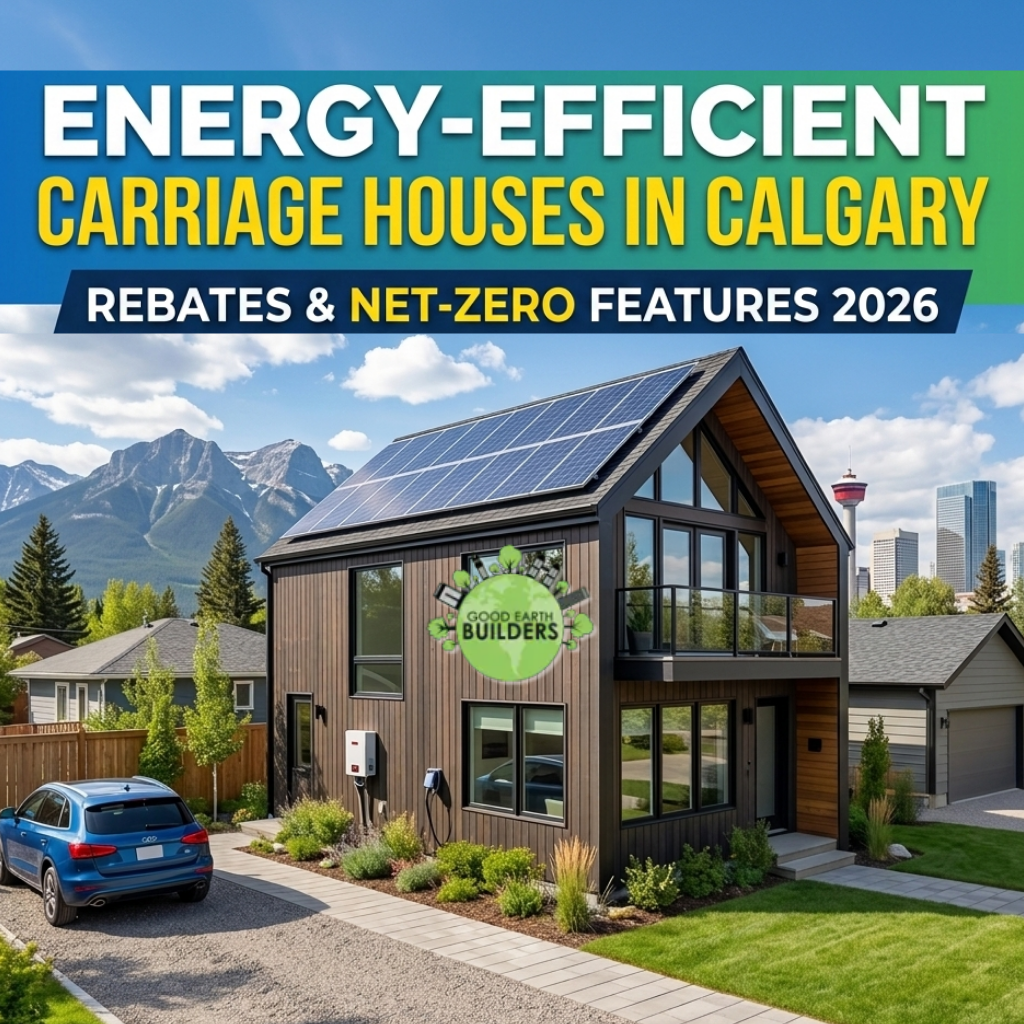
Friday, March 06, 2026
Adding a carriage house (also called a laneway house, garden suite, coach house or backyard suite) to your Calgary property is one of the most practical and profitable home improvements you can make right now. These small detached secondary dwellings — usually built over a garage or as a standalone unit in the backyard — give you extra space for aging parents, adult children, rental income, a home office, or guests. In a city where legal secondary suites can rent for $1,500–$2,500/month and add $150,000–$350,000+ to your property value, the financial case is already strong.
But in 2026 the financial case becomes even stronger when you build the carriage house to be energy-efficient or even net-zero ready. Why? Because Calgary and Canada have layered multiple rebate, grant, refund and low-interest financing programs that reward exactly these kinds of upgrades — and many of them are still generous and fully available in 2026.
This long, practical guide explains everything a Calgary homeowner or investor needs to know about building an energy-efficient carriage house in 2026:
- What “energy-efficient” and “net-zero ready” actually mean for a small secondary suite
- The most valuable energy features to include (heat pumps, insulation, solar, HRV, etc.)
- Every major rebate, refund, grant and financing program still open in 2026
- Realistic costs and payback periods
- How to stack incentives to cut your net cost by 20–40%
- Step-by-step process to qualify and claim
- Real Calgary examples and lessons learned
- Common mistakes that cause people to miss thousands in rebates
- What’s likely to change (or stay the same) after 2026
By the end you should have a clear, realistic plan — whether your goal is maximum rental income, lowest possible operating cost, highest resale value, or all three.
First: What “Energy-Efficient” and “Net-Zero Ready” Mean for a Carriage House
A standard carriage house uses conventional electric baseboard heat or a small gas furnace, code-minimum insulation, standard windows, and basic ventilation. Monthly utility bills in winter can easily run $150–$300 even for a 600–900 sq ft suite.
An energy-efficient carriage house uses modern systems and materials to cut that number by 40–70% — often bringing winter bills down to $50–$100/month.
A net-zero ready carriage house goes further: the suite produces (or is capable of producing) as much energy as it consumes on an annual basis, usually through a combination of super-high insulation, air-tightness, heat pumps, solar PV panels, and sometimes battery storage.
In Calgary’s cold, sunny climate both approaches make strong financial sense — especially when rebates cover a large portion of the incremental cost.
The Most Valuable Energy Features to Include in 2026
Here are the upgrades that give the biggest bang for your buck (and the biggest rebate eligibility) in a Calgary carriage house:
- Cold-Climate Air-Source Heat Pump
- Replaces baseboard heat or gas furnace
- Works efficiently down to –25 °C or lower
- Provides both heating and air-conditioning
- Typical added cost: $6,000–$12,000
- Annual savings: $800–$1,800 (40–70% reduction in heating bills)
- High-Performance Insulation & Air-Sealing
- Attic R-50+, walls R-24+, slab/under-floor R-20+
- Blower-door tested air-sealing (ACH50 < 2.0)
- Typical added cost: $4,000–$10,000
- Annual savings: $500–$1,200
- Triple-Pane, Low-E, Argon-Filled Windows
- U-value ≤ 0.20, SHGC optimized for Calgary
- Typical added cost: $3,000–$8,000
- Annual savings: $300–$800 + huge comfort improvement
- Heat-Recovery Ventilator (HRV or ERV)
- Brings in fresh air while recovering 70–85% of the heat
- Typical added cost: $2,500–$5,000
- Annual savings: $200–$500 + much better indoor air quality
- Solar PV + Solar-Ready Conduit
- 4–8 kW system (enough to offset most of the suite’s electricity)
- Typical added cost: $12,000–$22,000 (after current incentives)
- Annual savings: $800–$2,000+ (net metering)
- Heat-Pump Water Heater
- Replaces standard electric tank
- Typical added cost: $2,500–$4,500
- Annual savings: $400–$800
- LED Lighting + Smart Controls
- Low incremental cost ($500–$2,000)
- Annual savings: $100–$300
When you combine several of these features, total added cost is usually $20,000–$50,000 — but rebates and long-term savings can bring the net cost down to $10,000–$25,000 or less.
Every Major Incentive Still Available in Calgary / Alberta in 2026
1. CMHC Eco Improvement Refund (Federal)
What it is: 25% refund on your CMHC mortgage insurance premium when you spend ≥ $20,000 on energy-efficient upgrades. Typical benefit: $1,500–$5,000+ (depends on your mortgage premium) Eligibility for carriage house: Yes — if the upgrades are part of a larger home renovation or the carriage house is included in the mortgage. How to claim: Pre- and post-EnerGuide audits + invoices submitted within 2 years of mortgage closing. Link: CMHC Eco Improvement Program
2. Clean Energy Improvement Program (CEIP) – City of Calgary
What it is: Low-interest financing repaid through property taxes + up to 10% rebate on total project cost. Typical benefit: $2,000–$15,000 rebate on a $20,000–$150,000 project Eligibility: Energy efficiency upgrades (insulation, heat pumps, solar, windows, HRV, etc.) How it works: No upfront cash needed; repay over 5–20 years via property tax bill. Link: City of Calgary CEIP
3. Secondary Suite Incentive Program – City of Calgary
What it is: Grant for legal secondary suites (including carriage houses) Typical benefit: Up to $25,000 toward construction costs Eligibility: Must meet city bylaws; suite must be registered and legal Link: Calgary Secondary Suites Incentives
4. Alberta Municipal Solar Program / Solar Rebates
What it is: Rebates for solar PV systems (varies by municipality/utility) Typical benefit: $0.50–$1.00 per watt (up to several thousand dollars) Eligibility: Grid-tied solar on residential properties
5. Federal Oil-to-Electric-Heat-Pump Switching Programs (if still active)
What it is: Targeted rebates for switching from oil or inefficient electric heat to cold-climate heat pumps Typical benefit: $5,000–$10,000
6. GST/HST New Housing Rebate
What it is: Partial rebate on GST/HST for new secondary suites under certain value thresholds Typical benefit: Up to several thousand dollars
Stacking Example (very common in 2026): $80,000 carriage house build → $8,000 CEIP rebate → $3,000–$5,000 CMHC refund → $15,000–$25,000 city secondary suite grant → $2,000–$5,000 solar rebate → $2,000–$4,000 GST rebate
Total incentives: $30,000–$47,000 → net cost reduced to $33,000–$50,000
Realistic Cost Breakdown for an Energy-Efficient Carriage House in Calgary 2026
Base (code-minimum) carriage house (700–900 sq ft): $140,000–$220,000 Energy-efficient / net-zero ready version: $180,000–$280,000 Incremental cost for efficiency features: $20,000–$60,000
Typical upgrades that pay back fastest:
- Cold-climate heat pump + HRV: +$10,000–$18,000 → $800–$1,800/year savings
- High-performance insulation & air-sealing: +$6,000–$12,000 → $500–$1,200/year
- Triple-pane windows: +$5,000–$10,000 → $300–$800/year
- Solar PV (4–6 kW): +$12,000–$20,000 → $800–$2,000/year
Payback period with incentives: 4–8 years for most packages After-payback annual savings: $2,000–$5,000+
Step-by-Step Process to Maximize Incentives in 2026
- Confirm zoning & permitting (City of Calgary secondary suite rules)
- Get pre-construction EnerGuide audit (~$400–$600)
- Design with efficiency in mind (heat pump, insulation, solar-ready conduit)
- Apply for CEIP financing & rebates before starting work
- Apply for CMHC Eco Improvement if you have an insured mortgage
- Submit for provincial/city grants (secondary suite & affordable housing streams)
- Build with certified contractors (required for most rebates)
- Post-construction EnerGuide audit and submit all invoices
- Claim refunds/rebates (usually 4–12 weeks processing)
Real Calgary Carriage House Examples (2024–2025 projects still relevant)
- Bowness (2025): 750 sq ft carriage house over garage. Total cost ~$190,000. Received $18,000 in combined rebates/grants. Rents for $2,100/month → 9.5% gross yield.
- Killarney (2025): 900 sq ft net-zero ready laneway house. Added $35,000 in efficiency features → received $28,000 back via CEIP/CMHC. Winter bills ~$80/month.
- Highland Park (2025): Carriage house with solar + heat pump. Net cost after incentives ~$135,000. Adds $250,000+ to property value per recent appraisal.
Common Mistakes That Cost People Thousands in Rebates
- Not doing pre- and post-EnerGuide audits
- Starting work before getting CEIP approval
- Using non-certified contractors
- Missing the 2-year window for CMHC refund
- Not stacking incentives (many people only claim one program)
- Building to minimum code instead of net-zero ready
Avoid these and you can easily capture an extra $10,000–$30,000 in savings.
What’s Likely to Change After 2026?
Most experts expect the major programs (CMHC Eco, CEIP, secondary suite grants) to continue into 2027–2028, possibly with tighter eligibility or slightly lower rebate percentages as housing supply increases. Net-zero requirements in building codes are expected to become stricter by 2030, so building above code now can save expensive retrofits later.
Bottom line: 2026 still offers one of the strongest incentive windows Calgary has seen in recent years.
If you’re seriously considering a carriage house and want to make sure you capture every available rebate and design the suite to be as efficient and valuable as possible, it pays to work with builders who have already navigated these programs many times.
Good Earth Builders, with over 23 years of experience in the Calgary market and 846 completed projects, has built dozens of energy-efficient carriage houses, laneway suites and backyard secondary dwellings. They are very familiar with the current CMHC, CEIP, and secondary suite incentive rules, and they routinely help homeowners and investors design and build suites that maximize rebates while delivering strong rental income and resale value. Their commitment to planting 10 trees for every job also adds a meaningful environmental benefit to each project.
If you’re thinking about adding a carriage house in 2026 and want practical advice on incentives, net-zero features, realistic costs, timelines, and design choices that will give you the best long-term return, reaching out to a team like Good Earth Builders can save you time, money, and a lot of headaches.