Friday, January 02, 2026
As we kick off 2026, Calgary’s real estate market continues to buzz with activity, particularly in urban infill projects. These developments—replacing older homes with duplexes, row homes, 4-plexes, or even larger multi-family units in established neighborhoods like Bowness, Killarney, or Forest Lawn—are a smart way to meet housing demand without sprawling into new suburbs. They add density, boost property values, and make efficient use of existing infrastructure. However, construction costs remain a major hurdle. After years of volatility driven by supply chain disruptions, labor shortages, and global events, costs are showing signs of stabilization. According to recent reports, Canadian construction costs saw moderate increases in 2025, with residential sectors experiencing about 4.4% growth in 2024, and projections for 2026 indicate flat to slight rises of 0-3% on average for materials. Labor markets are weakening slightly, with unemployment expected to tick up to 4.7% in 2026, potentially easing wage pressures but still highlighting shortages in skilled trades.
Inflation, while cooling from peaks, continues to impact budgets—material prices like lumber and steel have stabilized after wild swings, but items like mechanical systems could see 10% increases. For infill developers and homeowners, this means finding ways to control expenses without cutting corners on quality or sustainability. Two standout strategies are prefabricated (prefab) and modular construction, which can reduce timelines by 20-50% and costs by 10-20%, and local material sourcing, which minimizes transport fees and supports Alberta’s economy. These methods are especially effective for infill, where tight lots, neighbor considerations, and quick turnarounds are key.
In this in-depth guide, we’ll break down the current cost landscape in Calgary for 2026, explore how prefab and modular building save money with real examples, discuss the advantages of local sourcing, show how to combine these strategies, and provide practical tips for your next project. Whether you’re a developer eyeing a row home build or a homeowner planning a carriage house addition, these approaches can help you beat inflation and deliver profitable, high-quality results.
Understanding Calgary’s Construction Cost Challenges in 2026
To effectively save costs, it’s crucial to understand what drives them up in the first place. Calgary’s construction sector, like much of Canada, has been on a rollercoaster. The Normac 2025 Construction Cost Trends report notes that costs softened throughout 2024, with moderate Q3 increases of 4.0% for residential projects. Moving into 2026, forecasts from On-Site Magazine suggest an optimistic outlook for infrastructure but a crossroads for overall activity, with labor markets weakening and unemployment rising from 4.0% in 2024 to 4.7% in 2026. This could ease some wage pressures, but skilled trades shortages persist, pushing labor costs higher in specialized areas like electrical and plumbing.
Material prices are a mixed bag. Statista data shows construction costs in Canada increased by just 4.4% for housing in 2024, down from sharper rises earlier. For 2026, experts like Construction Cost Accounting predict continued stability with inflation-level increases of 2-4% for many categories. However, specific items vary: Industrial distribution costs jumped 3-5% in 2025, while glass saw declines of 15-20%. Lumber, a staple for infill framing, has stabilized after 2021-2022 spikes, but potential tariffs on imports could add 2-5% pressure, as noted in the Calgary and Region Economic Outlook.
Regulatory and site-specific costs hit infill hard. For townhomes, hidden fees like permits, utilities, and land servicing can average $146,000 per unit, according to industry analyses. In Calgary, development permit fees, environmental assessments, and compliance with zoning for things like parking or setbacks add layers. Weather plays a role too—winter delays can inflate budgets by 10-15% through extended timelines and equipment rentals.
The broader economy influences this: TD Economics forecasts ramped-up provincial capital spending in 2026, which could compete for labor and materials, potentially nudging costs up. The Industrial Product Price Index (IPPI) for construction materials rose moderately in Q3 2024, providing insights into ongoing trends. Overall, the Canada construction market is projected to grow from USD 283.63 billion in 2024 to USD 349.78 billion by 2030 at a 3.36% CAGR, indicating steady but manageable increases.
For infill specifically, these challenges amplify because of limited space: Cranes and equipment access is trickier, and neighbor disruptions can lead to complaints or stoppages. Inflation erodes profits if not managed— a 3% material hike on a $500,000 project adds $15,000. That’s why strategies like prefab and local sourcing are game-changers, helping lock in prices and streamline processes.
The Power of Prefab and Modular Construction for Cost Savings
Prefab and modular construction involve building components or entire sections in a factory, then transporting and assembling them on-site. This method has gained traction in Calgary for infill, where speed and minimal disruption are key.
Let’s break down the savings:
Faster Build Timelines Reduce Holding Costs
Traditional infill builds can take 8-12 months, exposed to weather delays that add weeks and thousands in costs. Prefab cuts this by 20-50%, often to 4-6 months, through parallel work: Factory production while site prep happens.

In Calgary’s short construction season, this avoids winter shutdowns. Shorter timelines mean less interest on loans and quicker occupancy or sales.
Lower Labor and Material Expenses
Factories use assembly-line efficiency, reducing on-site labor by 30-50%—fewer workers mean lower wages and insurance. Waste drops to under 5% (vs. 20-30% on-site), and bulk buying locks in material prices early, shielding from inflation spikes. Overall savings: 10-20% on total costs.
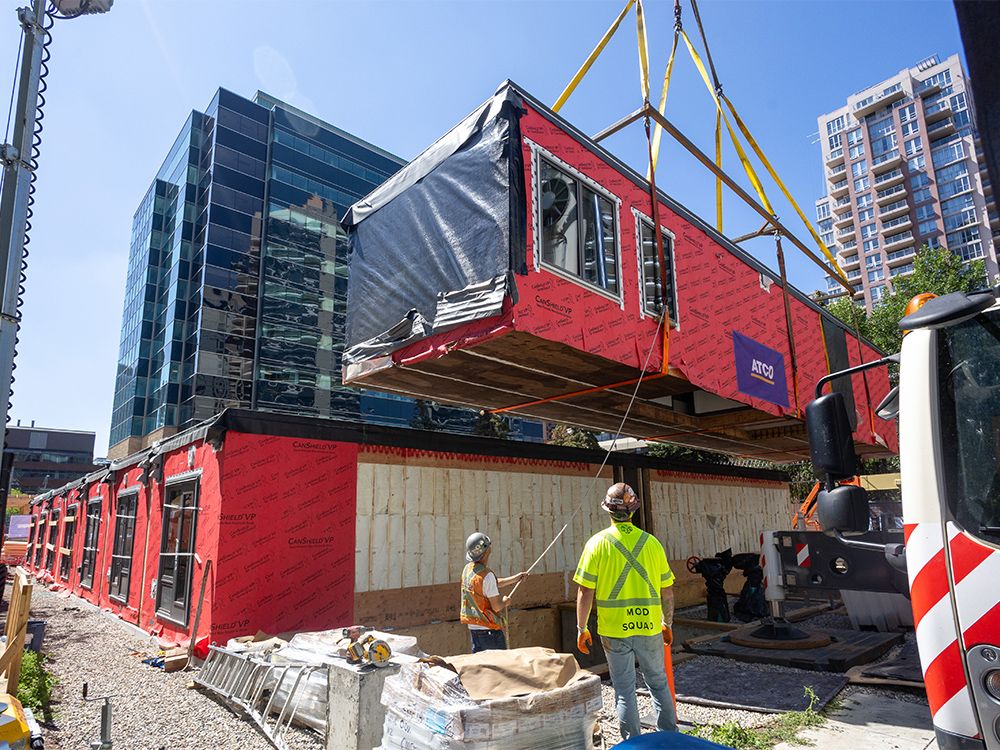
Pros for infill: Less noise/dust for neighbors, modules fit tight lots via cranes. Cons: Upfront planning costs and transport fees, but these are offset by speed.
Real example: ATCO’s modular projects in Calgary, like the 84-unit affordable housing in downtown west, assembled in weeks, saving significantly on labor amid shortages.
In 2026, with costs stabilizing, prefab’s predictability shines—factory contracts fix prices, avoiding 2-4% inflation hits.
Quality and Sustainability Perks
Precision tools ensure better fits, reducing rework. Modular often includes energy-efficient features like superior insulation, cutting long-term utility costs and qualifying for rebates.
For Calgary: Handles cold with tight envelopes; sustainable by minimizing site impact.
Local Sourcing: Reducing Transport Costs and Supporting Alberta Suppliers
Local sourcing means buying materials from Alberta or nearby suppliers, cutting logistics while boosting the economy.
Savings on Shipping and Delivery
Transport can add 5-10% to material costs for imported items. Local lumber from Alberta mills or aggregates from quarries near Calgary slash this—shorter hauls mean lower fuel fees and faster delivery, avoiding delays that inflate budgets.
In 2026, with global chains still vulnerable (e.g., tariffs on imports), local insulates from volatility.
Faster and More Reliable Supply
No waiting for overseas shipments; just-in-time delivery reduces storage needs. For infill, where space is limited, this is huge.
Quality Tailored to Local Conditions
Alberta-sourced materials like spruce lumber suit the climate—resistant to freeze-thaw cycles. Suppliers like TimberTown or local concrete plants offer competitive pricing with bulk deals.
Pros: Lower carbon footprint, community support. Cons: Limited variety for specialty items.
Real case: Many Calgary infills use regional steel or wood, saving 5-15% on logistics amid stabilizing prices.

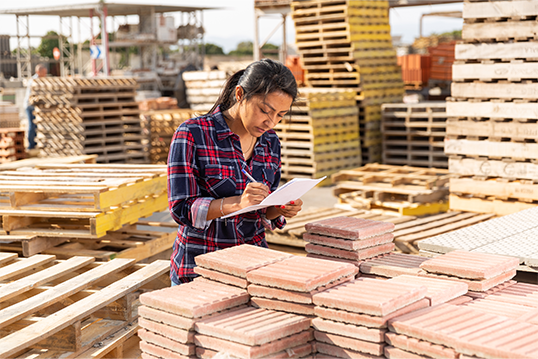

Combining Strategies and Other Tips for Maximum Savings
Layer prefab with local sourcing: Factories use regional materials for double savings—efficiency + low transport.
Other tips:
- Standard Designs: Reuse plans to cut engineering fees.
- Bulk Buying: For multi-unit infill, negotiate discounts.
- Reused Materials: Salvage from demos for 10-20% savings.
- Incentives: Calgary’s Infill Fast Track speeds permits; green features qualify for rebates.
- Phased Builds: Minimize downtime.
Pros/cons: Combining adds complexity but maximizes ROI.
Case study: A Calgary developer using prefab modules from local factories saved 15% on a row home project, completing in 5 months.
Outlook for 2026: Opportunities in Calgary Infill
Calgary remains a leader in housing starts per capita, with infill playing a central role in meeting demand amid population growth. Stabilizing costs create a window for profitable projects—modest inflation means savings strategies yield even higher relative returns.
Prefab adoption is accelerating, supported by local factories and incentives. Local sourcing gains traction as sustainability mandates grow. Together, they enable faster, greener, more affordable infill that aligns with net-zero goals.
The result: Stronger margins, happier buyers/renters, and sustainable urban growth.
When planning your infill project, consider partnering with builders experienced in these methods. Good Earth Builders, with over 23 years in Calgary and 846 completed projects, specializes in cost-effective, high-quality infill developments like duplexes, row homes, and multi-family units. Their commitment to environmental responsibility—including planting 10 trees per job—complements efficient, sustainable approaches. Reach out to them for a consultation to explore how prefab, local sourcing, and other strategies can optimize your 2026 project.