Monday, February 16, 2026
Building a carriage house—also known as a laneway house, garden suite, or coach house—in Calgary is becoming one of the most popular ways for homeowners to add value to their property in 2026. These detached secondary suites, often built above garages or in backyards, provide extra living space for family members, rental income, or even a home office. With Calgary’s housing market facing ongoing shortages and high demand for affordable rentals (vacancy rates around 4-6%), a carriage house can generate $1,500-$2,500/month in rent while increasing your home’s overall value by 10-20%.
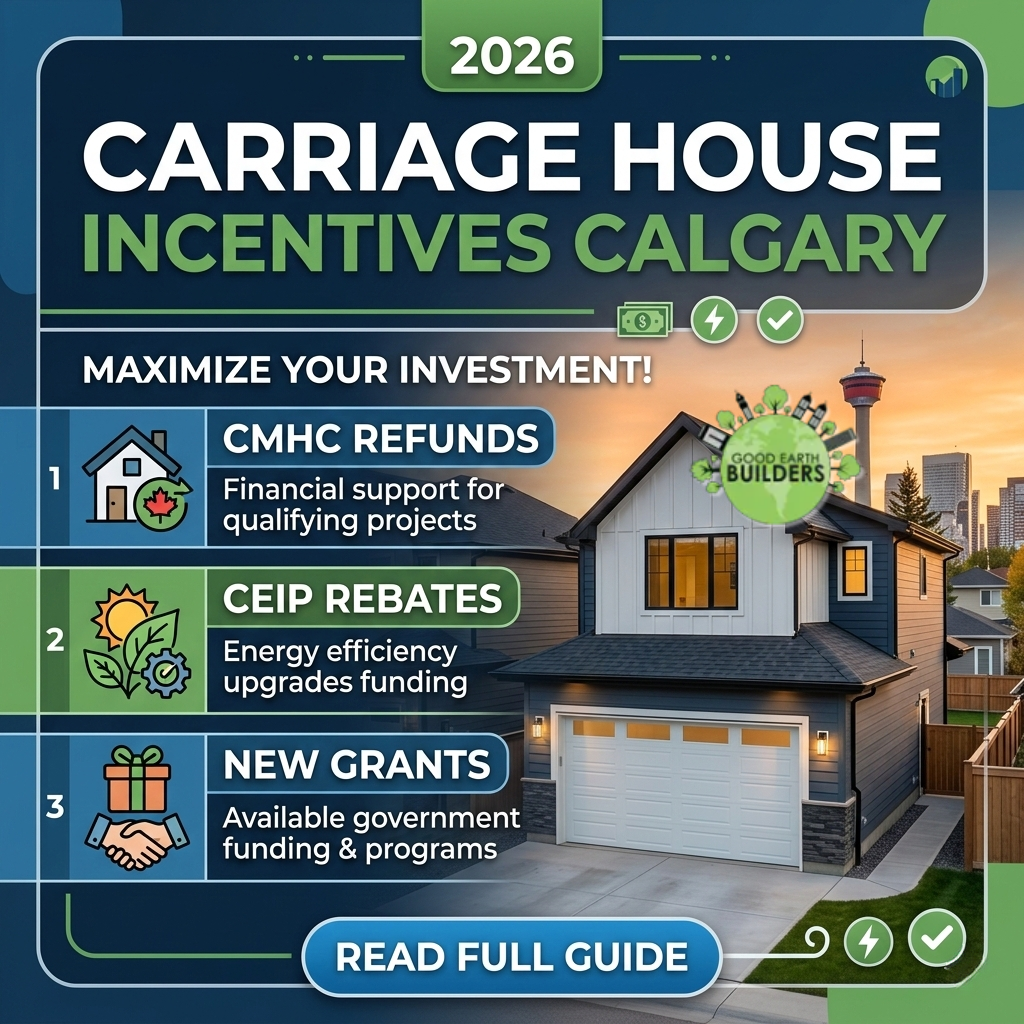
The best part? Government incentives at federal, provincial, and municipal levels make building a carriage house more affordable than ever. Programs like the CMHC Eco Improvement refund (up to 25% back on mortgage premiums for energy-efficient upgrades), the City of Calgary’s Clean Energy Improvement Program (CEIP) rebates (up to 10% off project costs), and various grants can cover thousands of dollars in expenses. In 2026, with construction costs stabilizing (2-4% inflation forecast) and material prices like lumber holding steady, these incentives can reduce your net cost by 15-30%, turning a good investment into a great one.
This full guide explains the key carriage house incentives available in Calgary for 2026. We’ll cover what carriage houses are, why incentives matter now, detailed breakdowns of CMHC refunds, CEIP rebates, provincial and city grants, eligibility requirements, how to stack them for maximum savings, application tips, real-world examples, common challenges with solutions, and a look ahead at trends. By the end, you’ll have a clear, step-by-step understanding to get started—whether you’re a homeowner adding a backyard suite or an investor building for rental income.
What is a Carriage House and Why Build One in Calgary?
A carriage house is a small, detached secondary dwelling on the same lot as your main home, often built over a garage or as a standalone structure in the backyard. In Calgary, they’re allowed under the Land Use Bylaw as “backyard suites” or “laneway homes,” typically up to 1,000 sq ft with 1-2 bedrooms, a kitchen, and bathroom. They’re perfect for multi-generational living (aging parents or adult children), rental units to offset mortgage costs, or even short-term Airbnb rentals (check local rules).
Why build one in 2026? Calgary’s housing crisis continues, with CMHC forecasting steady demand for rentals amid population growth. A carriage house can add $200,000-$400,000 to your property value while generating passive income. Plus, with stabilizing construction costs (average $200-$350 per sq ft for carriage houses), and incentives covering 15-30% of expenses, the ROI is stronger than ever. In hail-prone Calgary, using resilient materials qualifies for extra rebates, making it a smart, future-proof investment.
For visual inspiration, check out City of Calgary Backyard Suites Gallery or Pinterest Carriage House Designs.
Why Incentives Matter for Carriage Houses in 2026
Incentives are financial tools from governments to encourage more housing supply and sustainability. In Calgary, where carriage houses help with density without sprawl, these programs reduce your upfront costs and improve long-term savings. With 2026 construction inflation at 2-4%, incentives can offset rising material prices (lumber flat, steel up slightly). They also align with Alberta’s climate goals, rewarding energy-efficient designs that cut emissions and bills.
Key benefits:
- Cost Reduction: Rebates/refunds cover 15-30% of project costs.
- Faster ROI: Energy upgrades pay back in 3-7 years through lower utilities.
- Increased Value: Green features add 5-10% to resale.
- Insurance Savings: Efficient homes qualify for discounts.
Now, let’s detail the main incentives.
CMHC Refunds for Carriage Houses in 2026
The CMHC Eco Improvement program is a federal incentive that refunds up to 25% of your mortgage loan insurance premium if you spend at least $20,000 on energy-efficient upgrades for a recently purchased or refinanced home. For carriage houses, this applies if the upgrade is part of a larger renovation or if the suite is energy-focused.
How It Works: If your mortgage is CMHC-insured (down payment <20%), complete upgrades like insulation or heat pumps, submit invoices, and get the refund. For a $10,000 premium, that’s $2,500 back. Eligibility for Carriage Houses: Upgrades must improve energy efficiency; carriage houses qualify if they include legal suites with efficient features. Apply within 2 years of mortgage closing. Amount: Up to 25% (thousands depending on premium). Application Tips: Get an EnerGuide audit pre/post ($300-$600); use certified contractors. Submit via CMHC portal: CMHC Eco Improvement. Real Example: A Calgary homeowner added a carriage house with heat pump in 2025, spent $25,000 on upgrades, and got $3,000 CMHC refund plus energy savings. Pros: Easy to qualify; stacks with others. Cons: Requires CMHC mortgage; minimum spend.
For more, visit CMHC Homeowner Tools.
CEIP Rebates for Carriage Houses in 2026
The City of Calgary’s Clean Energy Improvement Program (CEIP) finances energy upgrades through property taxes, with up to 10% rebates on total costs. For carriage houses, this covers insulation, heat pumps, solar, and more.
How It Works: Finance upgrades (interest 3.75% in 2025, similar in 2026), repay via taxes, get 10% back. For a $50,000 carriage house upgrade, rebate $5,000. Eligibility: Carriage houses as secondary suites; upgrades must meet energy standards. Program reopens in 2026 after 2025 capacity. Amount: Up to 10% (thousands for full builds). Application Tips: Apply via City of Calgary CEIP; use approved contractors; get energy audit. Real Example: A Bowness carriage house with solar and insulation got $4,500 CEIP rebate in 2025, reducing net cost. Pros: No upfront cash; stacks with CMHC. Cons: Tied to property taxes; limited funding.
Provincial & City Grants for Carriage Houses in 2026
Alberta’s Affordable Housing Partnership Program and Calgary’s grants support carriage houses as secondary suites.
Alberta Program: Grants up to $100,000 for affordable rentals, including suites. Eligibility: Carriage houses with below-market rents. Apply via Alberta Housing. Amount: $50,000-$100,000 per project. City Grants: Calgary’s Secondary Suite Program offers up to $25,000 for legal suites, including carriage houses. Apply via City of Calgary Secondary Suites. Application Tips: Submit plans showing affordability. Real Example: 2025 grant helped build a rental carriage house in Mount Pleasant. Pros: Direct funding. Cons: Affordability requirements.
For more, see Government of Alberta Grants.
Eligibility and Application Process for 2026 Incentives
Eligibility: Own the property, meet energy/affordability standards, use certified contractors.
Process:
- Energy audit.
- Choose upgrades.
- Apply for incentives.
- Install.
- Submit for rebates.
Tips: Stack CMHC + CEIP + grants.
Stacking Incentives for Maximum Savings
Stack CMHC refund + CEIP rebate + grants for 30%+ savings. Example: $100,000 carriage house gets $25,000 total back.
Real-World Examples
- 2025 Bowness: $80,000 carriage house with heat pump got $8,000 CEIP + $2,500 CMHC.
- Killarney: Grant-funded suite rents for $1,800/month.
Challenges and Solutions
Challenges: Permits, costs. Solutions: Fast-track, certified builders.
Final Thoughts: Why 2026 Is One of the Best Years to Build a Carriage House in Calgary
When you look at everything we’ve covered — the rising housing demand, the ongoing affordability challenges, the strong rental market, and especially the generous stack of incentives still available in 2026 — one thing stands out very clearly: this is an unusually favorable window to build a carriage house in Calgary.
These incentives aren’t temporary gimmicks or one-year programs that might disappear. The CMHC Eco Improvement refund (up to 25% back on your mortgage premium for energy-efficient upgrades), the City of Calgary’s Clean Energy Improvement Program (CEIP) with its 10% rebate on qualifying work, the provincial affordable housing grants (up to $100,000 per project for below-market rentals), and the city’s own Secondary Suite Program (up to $25,000 for legal suites) are all part of long-term strategies to increase housing supply, promote sustainability, and help families and investors add value to their properties. And in 2026, these programs are still fully funded, active, and open to new applicants — with no major cuts announced yet.
On top of that, construction costs have largely stabilized after the wild swings of 2021–2024. Lumber prices are flat or only modestly up, steel and concrete costs are predictable, and labor availability is improving slightly with unemployment ticking up to around 4.7%. Interest rates remain in a range that supports well-structured financing, especially when you combine low-cost CMHC loans with CEIP’s tax-bill repayment model. All of this means your net out-of-pocket cost to build a carriage house can be 15–30% lower than it would have been a few years ago — and that’s before factoring in the long-term savings from lower utility bills, higher rental income, and increased property value.
The real power comes when you stack these incentives properly. A $100,000 carriage house project could realistically see:
- $5,000–$10,000 back from CEIP rebates on energy features
- $2,000–$5,000 from CMHC premium refunds (if you have an insured mortgage)
- $10,000–$25,000 from city or provincial secondary suite grants
- Additional savings from utility rebates and GST rebates
That’s potentially $20,000–$40,000+ in direct financial support — money that goes straight to your bottom line or lets you upgrade to higher-quality finishes, better insulation, or solar-ready wiring without increasing your budget.
But beyond the dollars, a carriage house in 2026 is also one of the most flexible and future-proof investments you can make in Calgary right now. You can use it for multi-generational living (keeping aging parents close or giving adult kids independence). You can rent it out long-term for steady passive income ($1,500–$2,500/month is very achievable in most neighborhoods). You can even use it for short-term rentals (check local bylaws) or as a home office/studio. And because these suites help increase overall housing supply, they align with city and provincial goals — which means more community support, faster permitting through Infill Fast Track, and less risk of future regulatory pushback.
The market timing feels right too. Rental demand is expected to tighten again as new purpose-built rentals take time to come online. Property values in mature neighborhoods continue to rise steadily. And buyers and renters are increasingly looking for energy-efficient, resilient homes — features that qualify for the very incentives we’ve discussed. A well-built carriage house with heat pumps, good insulation, and solar-ready wiring doesn’t just save money on utilities; it becomes a selling point if you ever decide to sell the property.
Of course, no project is risk-free. Permitting can still take time (even with Fast Track), costs can creep up if you don’t lock in quotes early, and you’ll need to plan carefully to meet zoning, setback, and parking rules. But the incentives, the market demand, the cost stability, and the flexibility all line up in a way that makes 2026 one of the strongest years in recent memory to move forward with a carriage house.
If you’re a homeowner thinking about adding rental income, creating space for family, or increasing your property’s value — or if you’re an investor looking for a relatively low-risk way to add to your portfolio — the question isn’t whether a carriage house makes sense. It’s whether you’re ready to take advantage of the incentives and market conditions while they’re still this favorable.
The opportunity is real. The programs are still generous. The demand is still strong. And the long-term upside — both financial and lifestyle — is hard to ignore.
If you’re ready to turn that opportunity into reality, working with experienced local builders who understand Calgary’s zoning, permitting process, incentive landscape, and the realities of building backyard suites can make all the difference between a smooth, profitable project and one full of surprises.
Good Earth Builders, with over 23 years of experience in the Calgary market and 846 completed projects, has built dozens of successful carriage houses, laneway suites, and secondary dwelling units. They specialize in efficient, high-quality infill and backyard developments, and they’re known for helping homeowners and investors navigate permits, maximize rebates, and deliver projects on time and on budget. Their commitment to planting 10 trees for every job also adds real environmental value to each build — something that aligns perfectly with the green incentives we’ve talked about.
If you’re thinking about a carriage house in 2026 and want expert guidance on incentives, design, costs, and timelines, reaching out to a team like Good Earth Builders can help you get started with confidence, clarity, and a realistic plan to maximize your savings and returns.