Monday, April 20, 2026
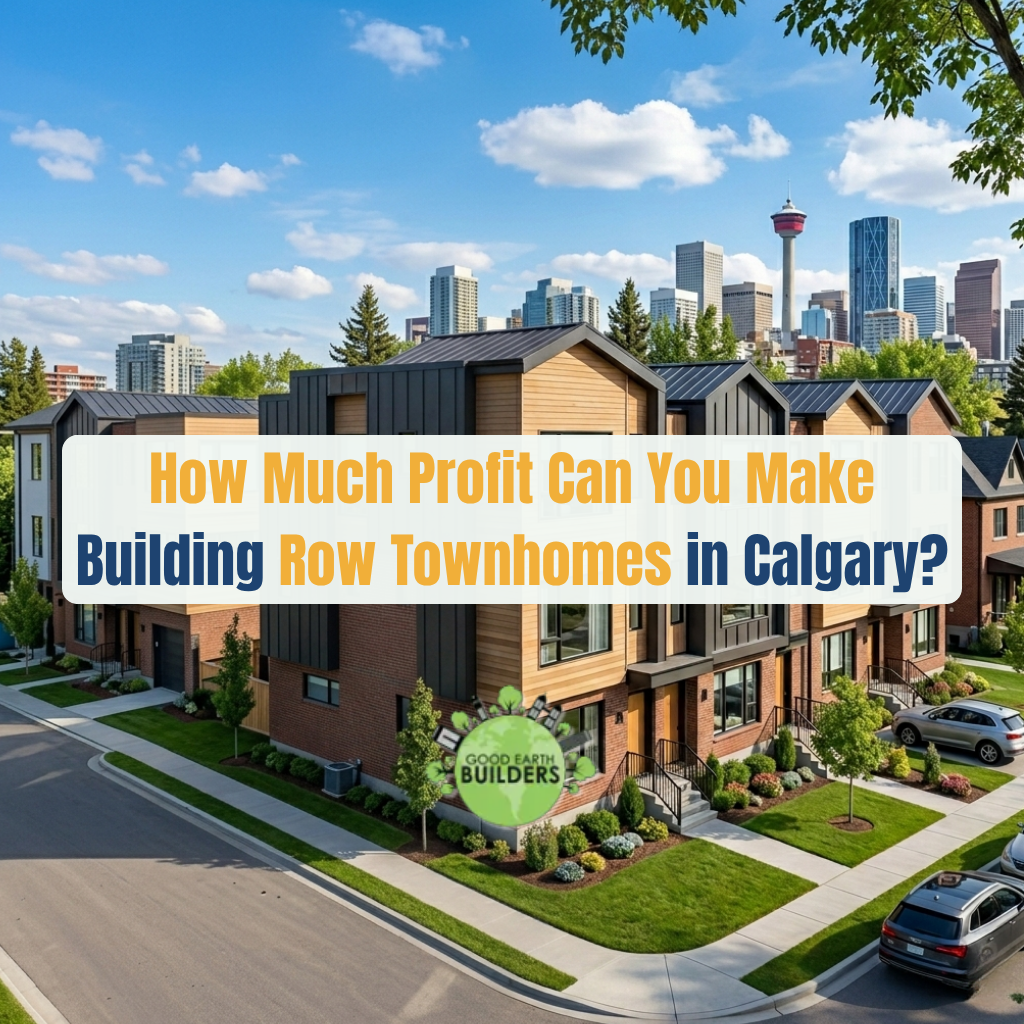
Row townhomes have become one of the most popular and profitable types of infill housing in Calgary. These attached homes — usually 3 to 8 units in a row with their own entrances and small private yards — offer a great middle ground between duplexes and larger apartment buildings.
Many developers and investors want to know one simple question: How much profit can you realistically make building row townhomes in Calgary right now?
The answer depends on location, project size, design choices, and how well you use available incentives. In 2026, with construction costs stabilizing and steady demand in many neighborhoods, well-planned row townhome projects often deliver strong returns. Typical gross profit margins range from 20% to 32%, and in good cases even higher.
This detailed guide breaks everything down in plain, easy-to-understand English. You’ll see realistic cost breakdowns, revenue projections, profit examples, how incentives boost your bottom line, what affects profits most, and practical tips to maximize your returns in Calgary’s 2026 market.
How Profit Is Calculated for Row Townhomes
Profit = Total Revenue − Total Costs
Developers usually calculate profit in two main ways:
- On Sale — Build and sell the units individually (strata title) for quick capital and profit.
- On Hold — Keep the building and earn rental income over many years.
- Hybrid — Sell most units and keep 1–2 for ongoing cash flow (very popular strategy).
In 2026, many successful projects use the hybrid approach to balance immediate profit with long-term income.
Typical Project Size and Numbers in 2026
Most row townhome projects in Calgary are 4 to 6 units on one or two combined lots.
Example Project (5-unit row townhome):
- Land cost: $750,000 – $1,100,000
- Construction cost: $1.4M – $2.1M
- Soft costs (permits, design, legal, etc.): $150,000 – $300,000
- Total Project Cost: $2.3M – $3.5M
Revenue if Sold:
- Average sale price per unit: $480,000 – $650,000
- Total sales revenue: $2.4M – $3.25M
Gross Profit: $400,000 – $900,000+ per project (20–32% margin)
This means a developer can potentially clear $500,000 to $800,000 in profit on a single well-executed 5-unit project after all costs.
Detailed Cost Breakdown (2026 Realistic Figures)
1. Land Acquisition
- Standard infill lot (100–150 ft wide): $650,000 – $950,000
- Two combined lots: $900,000 – $1.4M
- Demolition & site clearing: $20,000 – $45,000
2. Construction Costs
- Base building cost: $350 – $480 per sq ft
- For a 5-unit project (approx. 7,000–9,000 total sq ft): $1.4M – $2.2M
- Energy-efficient upgrades (heat pumps, insulation, etc.): add $80,000 – $180,000 (but often offset by incentives)
3. Soft Costs
- Design, engineering & consultants: $80,000 – $160,000
- Permits & city fees: $40,000 – $90,000
- Legal, financing & marketing: $30,000 – $70,000
Total All-In Cost: Usually $2.3M – $3.5M for a 5-unit row townhome project in good neighborhoods.
Revenue and Profit Scenarios in 2026
Scenario 1: Build & Sell All Units
- Total sales: $2.8M – $3.6M
- Total costs: $2.4M – $3.1M
- Gross Profit: $400K – $900K (average 24–28% margin)
- Net Profit after taxes & fees: Often $350K – $750K per project
Scenario 2: Hold for Rental Income
- Monthly gross rent (5 units): $12,000 – $18,000
- Annual gross rent: $144K – $216K
- Net yield after expenses: 6–8%
- Cash-on-cash return: Often 10–15% with good financing
Many developers use a hybrid model: Sell 3–4 units for immediate profit and keep 1–2 units for steady rental income.
How Incentives Boost Your Profit
Government programs can add tens or hundreds of thousands to your bottom line:
- Infill Fast Track → Saves 3–6 months of holding costs ($50K–$150K saved)
- CEIP Rebates → Up to 10% back on energy upgrades ($80K–$200K)
- CMHC Eco Refund → 25% back on mortgage insurance
- GST Rebate → Significant savings on new builds
- DIP Grants (in certain areas) → Extra cash for affordable components
Smart developers who design with incentives in mind often improve their margins by an extra 5–10%.
Factors That Most Affect Your Profit
Positive Factors:
- Choosing the right neighborhood (Highland Park, Forest Lawn, Killarney often perform best)
- Energy-efficient design (higher sale prices + rebates)
- Good project management (avoiding delays and overruns)
- Including legal basement suites (adds value and income)
Negative Factors:
- Overpaying for land
- Poor cost control during construction
- Long permitting delays
- Building in less desirable locations
Real-World Profit Examples from Calgary (Recent Projects)
- A 5-unit row townhome in Highland Park (2025) had total costs of $2.65M and sold for $3.45M → $800K gross profit (30% margin).
- A 4-unit project in Forest Lawn generated strong rental income with 8.2% yield after holding some units.
- Multiple hybrid projects in 2025–2026 delivered $450K–$700K immediate profit plus ongoing rental cash flow.
These examples show that $400,000 to $900,000+ profit per project is realistic for properly executed row townhomes in 2026.
Risks and How to Protect Your Profit
- Market slowdown → Mitigate by having a strong rental plan ready.
- Cost overruns → Use fixed-price contracts and experienced builders.
- Permitting delays → Start early and use Infill Fast Track.
- Interest rate changes → Lock in financing early when possible.
Building a contingency of 10–15% into your budget is standard practice among successful developers.
Comparison: Row Townhomes vs Other Infill Options
- Vs Duplex: Row townhomes usually deliver higher total profit because of more units.
- Vs 8-Plex: Row townhomes are simpler, easier to finance, and faster to sell.
- Vs Single Family Infill: Much better land efficiency and higher overall returns.
In 2026, row townhomes often offer the best balance of risk and reward for mid-sized infill projects.
Final Thoughts: Realistic Profit Potential in 2026
Building row townhomes in Calgary in 2026 can be very profitable. With good planning, realistic margins of 20–32% are achievable, often translating into $400,000 to $900,000+ profit per project. When you add rental income potential and the ability to use a hybrid sell-and-hold strategy, the overall returns become even more attractive.
Success depends on choosing the right location, controlling costs, designing for today’s buyers (energy efficiency, modern layouts, legal suites), and taking full advantage of available incentives and fast-track programs. The market still rewards well-built, thoughtfully designed row townhomes in family-friendly neighborhoods.
Row townhomes continue to be one of the smartest ways to participate in Calgary’s infill boom while delivering strong financial results for developers and investors.
If you are considering building row townhomes and want practical, experienced help with site selection, design, cost management, incentives, and project delivery, working with local builders who have completed many successful row townhome projects can make a big difference in your results.
Good Earth Builders, with over 23 years of experience in the Calgary market and 846 completed projects, has built numerous row townhome communities across the city. They understand the real costs, profit drivers, and local market conditions that determine success. Their commitment to planting 10 trees for every job also adds real environmental value to each development.
If you’re ready to explore building row townhomes in Calgary in 2026, reaching out to a team like Good Earth Builders can give you clear guidance, realistic profit projections, and support to help maximize your returns.