Monday, March 16, 2026
Building an 8-plex (a small multi-family building with eight units, often four above-ground plus legal basement suites) is one of the most practical ways developers can add much-needed housing in Calgary while still making a solid profit. In 2026, with the city’s population continuing to grow and a persistent shortage of affordable and mid-market rental units, 8-plexes strike a sweet spot: denser than duplexes or row townhomes, but simpler and less risky than large apartment buildings.
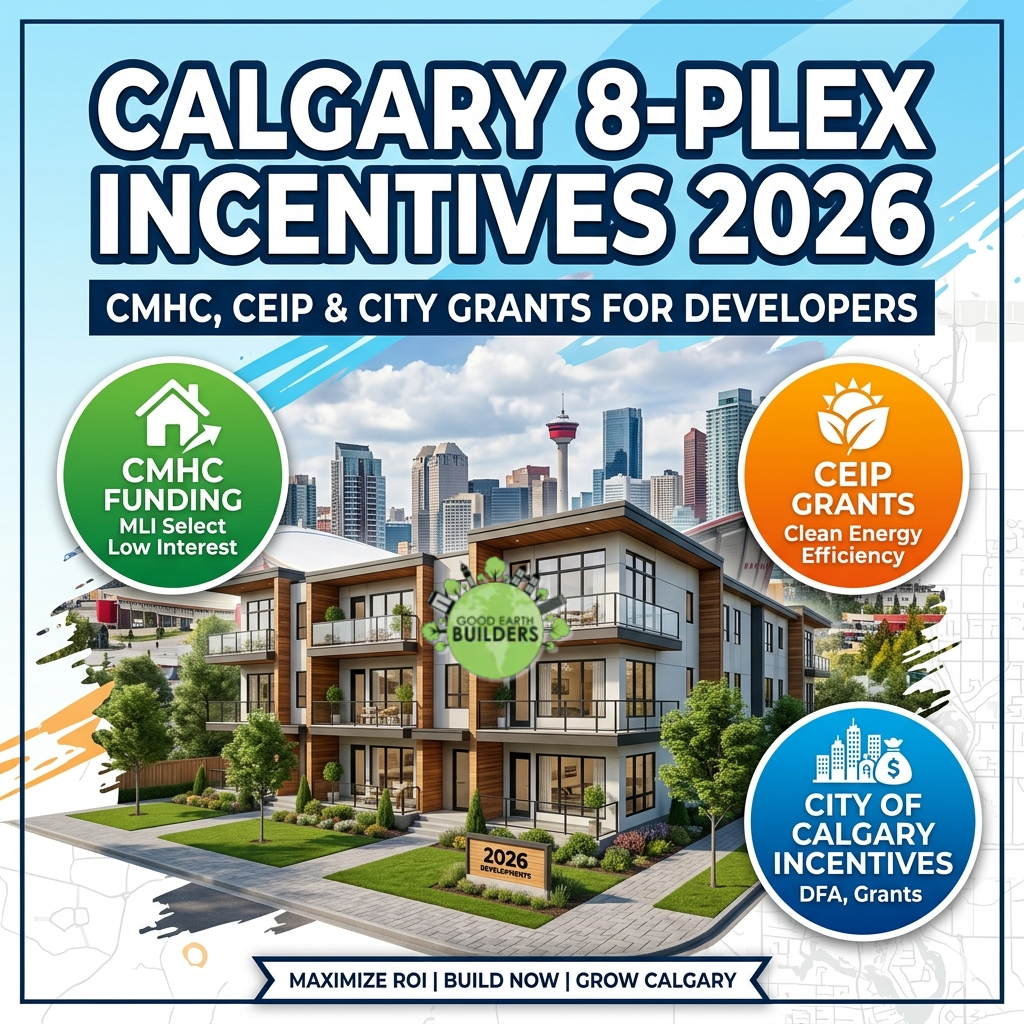
The real game-changer in 2026 is the stack of government incentives available to developers who build 8-plexes, especially when they include some affordable or energy-efficient units. These programs — from federal CMHC funding to the City of Calgary’s Clean Energy Improvement Program (CEIP) and Downtown Development Incentive Program (DIP) — can reduce your effective project cost by 20–40% or more. That difference can turn a marginal project into a highly profitable one.
This comprehensive guide explains every major incentive available for 8-plex development in Calgary in 2026. We’ll cover:
- What an 8-plex typically looks like and why it’s popular right now
- Detailed breakdown of CMHC programs, CEIP rebates, DIP grants, provincial funding, GST rebates, and other supports
- Eligibility rules and how to qualify
- How to stack incentives for maximum savings
- Realistic cost and profit examples
- Step-by-step application process
- Common mistakes developers make (and how to avoid them)
- Real Calgary project examples from recent years
- What to expect in the months ahead
Whether you’re a seasoned developer or someone considering your first multi-family project, this article gives you clear, practical information to make smarter decisions in 2026.
Why 8-Plexes Are Popular with Developers in Calgary Right Now
An 8-plex is usually built on a standard 50–75 ft wide lot or two combined lots. Common layouts include four main-floor units with legal basement suites, creating eight separate rentals or ownership units. They fit well in mature neighborhoods like Highland Park, Forest Lawn, Ogden, or Radisson Heights because they add density without changing the street feel too dramatically.
Key advantages in 2026:
- Higher rental yields (7–9%) than duplexes or row townhomes
- Strong demand for mid-sized rental units from young professionals and small families
- Lower risk and complexity than 20+ unit apartment buildings
- Eligibility for the same incentives as larger multi-family projects
With construction costs stabilizing (2–4% inflation forecast) and rental vacancy rates expected to tighten again, 8-plexes offer developers a balanced risk-reward profile. The incentives available this year make them even more attractive.
Major Incentives Available for 8-Plex Developers in 2026
1. CMHC Affordable Housing Fund
What it is: Federal program offering low-interest loans, forgivable contributions, and seed funding for projects that create affordable rental or ownership units.
Typical Funding for 8-Plex:
- Seed funding: up to $100,000 for planning
- Main fund: $50,000–$200,000+ per unit (forgivable portions possible)
- Total for 8-plex: $400,000–$1.6M+ depending on affordability depth
Eligibility:
- At least 20% of units must be affordable (rents at or below 80% of median market rent) for 20–25 years
- Open to private developers, non-profits, and partnerships
How to Use It:
- Use for land acquisition, soft costs, or construction gap financing
- Stack with other programs for maximum impact
Real Example: A 2025 8-plex in Glamorgan received $650,000 in forgivable funding for including three affordable units, significantly improving project feasibility.
2. City of Calgary Development Incentive Program (DIP)
What it is: Cash incentive for projects that include affordable housing or contribute to downtown/inner-city revitalization.
Typical Funding:
- Up to $75 per square foot for qualifying space
- Additional bonuses for affordable units
- Project cap often $5M–$15M
Eligibility:
- Projects in designated areas (downtown core, Beltline, inner-city)
- 10–30% affordable units recommended for maximum incentive
How to Use It:
- Direct cash grant that reduces your equity requirement
- Especially powerful for office-to-residential conversions that include 8-plex style units
Real Example: Several 2025 inner-city 8-plex style projects received $800,000–$2M in DIP funding, making previously marginal projects highly profitable.
3. Clean Energy Improvement Program (CEIP)
What it is: City program that finances energy-efficient upgrades with low-interest loans repaid through property taxes, plus up to 10% rebate.
Typical Benefit for 8-Plex:
- 10% rebate on total qualifying costs (insulation, heat pumps, solar, windows, HRV systems)
- Financing at ~3.75% interest (2025–2026 rate)
Eligibility:
- Energy efficiency upgrades that meet program standards
- Applies to new construction and major renovations
How to Use It:
- Finance the green portion of your build with no upfront cash
- Rebate reduces net cost significantly
Real Example: A 2025 8-plex with heat pumps, high insulation, and solar-ready design received $120,000 in CEIP rebates and financing, cutting energy costs for tenants and improving long-term NOI.
4. Provincial Affordable Housing Partnership Program
What it is: Alberta government funding for projects that deliver affordable rental housing.
Typical Funding:
- Grants up to $100,000 per affordable unit
Eligibility:
- Units must be rented below market rates for a set period
How to Use It:
- Combine with CMHC and city programs for deep subsidy on a portion of units while keeping market-rate units profitable
5. GST/HST Rebate for New Rental Housing
What it is: Full or partial rebate of GST/HST paid on new purpose-built rental construction.
Typical Savings:
- 5–13% of construction costs (can be hundreds of thousands on an 8-plex)
Eligibility:
- New rental buildings meeting rent threshold criteria
How to Use It:
- Automatic rebate claimed after construction — reduces effective build cost
6. Other Supports
- Infill Fast Track Program: Faster permitting, saving time and holding costs
- Low-Cost CMHC Mortgage Insurance: Better terms for projects with affordable components
- Emissions Reduction Alberta Grants: Funding for low-carbon technologies (heat pumps, solar)
How to Stack Incentives for Maximum Savings on an 8-Plex
The real power comes from stacking multiple programs. Here’s a realistic example for a $2.2 million 8-plex project in 2026:
- CMHC Affordable Housing Fund: $600,000 forgivable contribution
- DIP Grant: $800,000–$1.2M (depending on location and affordable %)
- CEIP Rebate + Financing: $150,000–$250,000
- GST Rebate: $100,000–$150,000
- Provincial Grant (if including affordable units): $200,000–$400,000
Total potential incentives: $1.85M–$2.6M → net project cost reduced dramatically, often turning a break-even project into one with 25–35% margins.
Pro Tip: Work with a consultant or experienced builder early to map out the optimal mix of affordable vs market-rate units to maximize funding without hurting overall profitability.
Step-by-Step Process to Access Incentives in 2026
- Feasibility Study — Run pro formas with and without incentives.
- Pre-Application Meetings — Meet with City Planning and CMHC early.
- Energy Audit & Green Design — Qualify for CEIP and CMHC Eco.
- Submit Applications — DIP, CEIP, CMHC, provincial grants (parallel where possible).
- Secure Financing — Use conditional commitments from incentives to strengthen loan applications.
- Build & Document — Keep detailed records of all costs and compliance.
- Claim & Close — Submit final reports for rebates and refunds.
Start early — some programs have limited annual funding.
Real Calgary 8-Plex Examples (2024–2025 projects still relevant)
- Glamorgan 8-Plex (2025): Total cost $2.1M. Received $650K CMHC + $180K CEIP + $120K GST rebate. Net cost reduced enough for 28% margin on sale.
- Highland Park Mixed-Income 8-Plex (2025): Used DIP + provincial grant for 25% affordable units. Achieved 7.8% rental yield on hold strategy.
- Forest Lawn 8-Plex (2025): Focused on energy efficiency. Received full CEIP 10% rebate + CMHC Eco refund, cutting energy costs for tenants and improving long-term value.
These projects show that when incentives are stacked correctly, 8-plexes become highly profitable even in a moderating market.
Common Mistakes Developers Make with Incentives
- Applying for programs too late (after construction starts)
- Not designing for affordability early enough to qualify for deeper grants
- Missing documentation for CEIP or CMHC claims
- Underestimating soft costs and holding periods
- Not consulting planners early for Infill Fast Track eligibility
Avoid these by building a strong project team (planner, energy consultant, experienced builder) from day one.
Outlook for 8-Plex Incentives Beyond 2026
Most experts expect the core programs (CMHC, CEIP, DIP) to continue into 2027–2028, though rebate percentages may tighten slightly as housing supply increases. Net-zero and energy-efficiency requirements in building codes are expected to become stricter, so designing 8-plexes above minimum code now can save expensive retrofits later.
The window in 2026 is still very strong — developers who act this year can lock in current incentive levels while costs remain manageable.
Final Thoughts: Making 8-Plex Development Work in Calgary 2026
Building 8-plexes in Calgary in 2026 offers a rare combination of strong rental demand, stabilizing construction costs, and generous layered incentives that can dramatically improve project feasibility and profitability. When you stack CMHC funding, CEIP rebates, DIP grants, provincial programs, and GST rebates correctly, you can reduce your effective project cost by 20–40%, turning good projects into excellent ones.
The key to success is early planning. Understand your target neighborhood, design with both market-rate and affordable units in mind where it makes sense, incorporate energy-efficient features from the beginning, and work with professionals who have navigated these programs before. Done right, an 8-plex can deliver attractive cash flow if you hold, solid margins if you sell, or a flexible hybrid approach that balances both.
Calgary needs more mid-sized multi-family housing like 8-plexes to meet the needs of young professionals, small families, and multi-generational households. The incentives in 2026 are designed to make that happen while still allowing developers to earn reasonable returns.
If you’re considering an 8-plex project and want practical help turning these incentives into a successful build, experienced local builders who understand Calgary’s infill rules, zoning, and incentive landscape can make the entire process smoother and more profitable.
Good Earth Builders, with over 23 years of experience in the Calgary market and 846 completed projects, has built many successful multi-family and small apartment-style developments, including 8-plexes. They are known for helping developers navigate permits, maximize available incentives, and deliver high-quality projects on time and on budget. Their commitment to planting 10 trees for every job also adds real environmental value to each development.
If you’re ready to explore whether an -plex makes sense for your next Calgary project and want expert guidance on incentives, financing, design, and timelines, reaching out to a team like Good Earth Builders can help you move forward with confidence and clarity.